









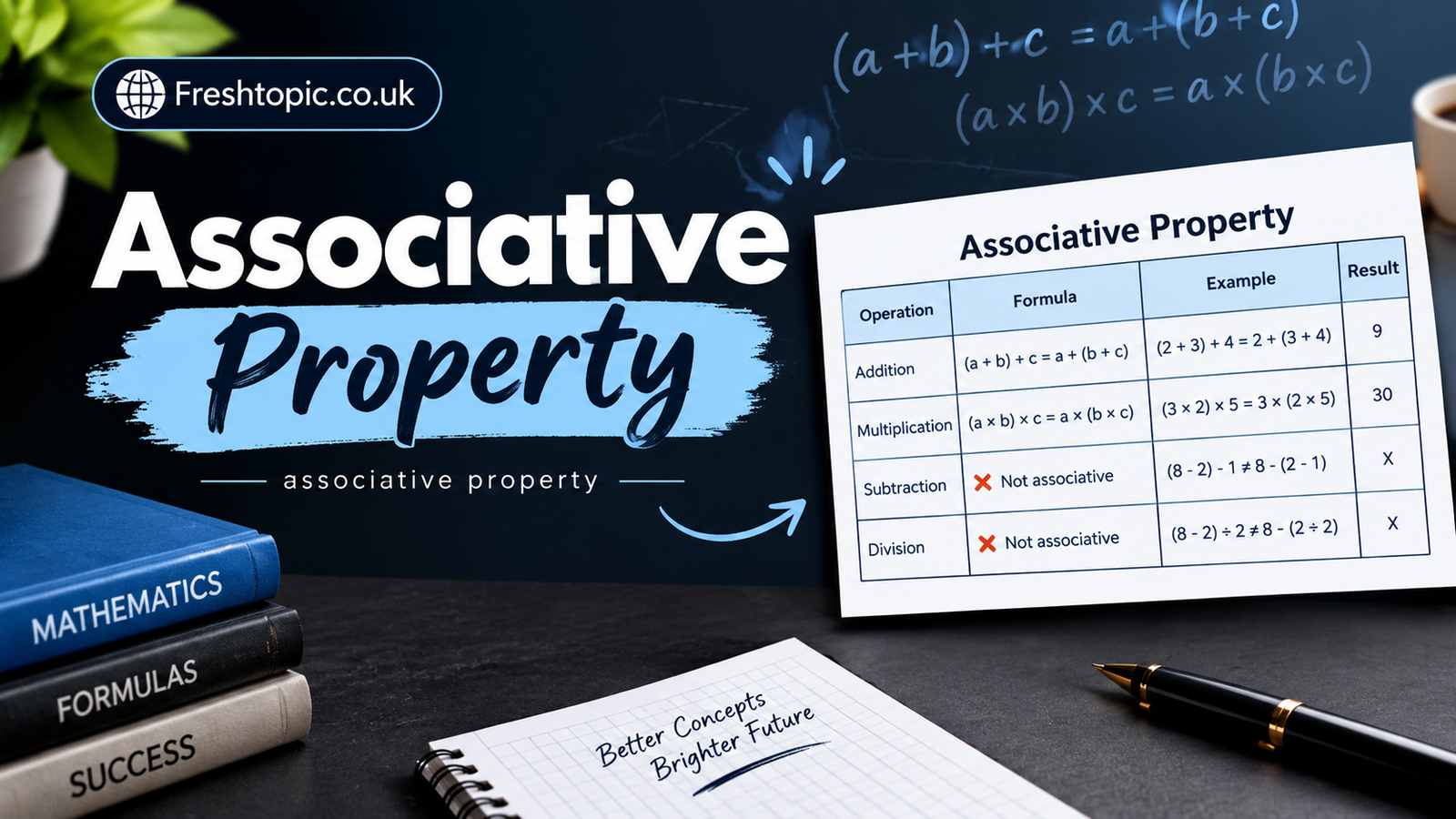
Staring at a math worksheet and wondering why (2 + 3) + 4 gives the same answer as 2 + (3 + 4)? You’re not alone. The associative property is one of the most commonly misunderstood — yet genuinely simple — rules in arithmetic, and it trips up students right before test day almost every year.
Here’s the good news: once you see it in action, it clicks fast. This guide walks you through the associative property of addition, the associative property of multiplication, real associative property examples, and the exact mistakes to avoid — so you (or your student) can answer any homework question with confidence in the next five minutes.
What Is the Associative Property?
The associative property states that when you add or multiply three or more numbers, the way you group them does not change the final answer.
In plain English: it doesn’t matter which numbers you calculate first — as long as the order of the numbers stays the same, the total stays the same.
This property only applies to addition and multiplication. It does not apply to subtraction or division.
The Associative Property Formula
For addition: (a + b) + c = a + (b + c)
For multiplication: (a × b) × c = a × (b × c)
The parentheses show which numbers get grouped and calculated first. The associative property guarantees the result is identical no matter which group you solve first. & more blogs digital .
Associative Property of Addition
The associative property of addition says that regrouping addends (the numbers being added) does not change the sum.
Addition Examples Step by Step
Example 1: (4 + 5) + 6 = 9 + 6 = 15 4 + (5 + 6) = 4 + 11 = 15
Both groupings equal 15. ✅
Example 2: (10 + 20) + 30 = 30 + 30 = 60 10 + (20 + 30) = 10 + 50 = 60
Same result either way. This is especially useful for mental math — students can group numbers that add up to round numbers (like 10 or 100) to solve problems faster.
Associative Property of Multiplication
The associative property of multiplication works the same way: regrouping the factors doesn’t affect the product.
Multiplication Examples Step by Step
Example 1: (2 × 3) × 4 = 6 × 4 = 24 2 × (3 × 4) = 2 × 12 = 24
Example 2: (5 × 2) × 7 = 10 × 7 = 70 5 × (2 × 7) = 5 × 14 = 70
Notice how grouping 5 × 2 first creates an easy “10,” making the rest of the problem simpler. This is exactly why the associative’s property is a genuine mental-math shortcut, not just a textbook rule.
side-by-side visual showing (2×3)×4 vs 2×(3×4) with matching arrows to 24. Alt text: “associative property of multiplication example showing (2×3)x4 equals 2x(3×4)”]
Associative Property vs. Commutative Property
Students frequently confuse the associative property with the commutative property, but they describe different rules.
- The commutative property is about order: a + b = b + a
- The associative property is about grouping: (a + b) + c = a + (b + c)
Comparison Table
| Property | What It Changes | Example | Works For |
|---|---|---|---|
| Associative Property | Grouping of numbers | (2+3)+4 = 2+(3+4) | Addition, Multiplication |
| Commutative Property | Order of numbers | 2+3 = 3+2 | Addition, Multiplication |
| Distributive Property | Multiplying a sum | 2×(3+4) = (2×3)+(2×4) | Multiplication over addition |
[Suggested image placement: infographic comparing associative, commutative, and distributive properties side by side. “associative property vs commutative property comparison table”]
Does the Associative Property Work for Subtraction and Division?
No. This is the single most common misconception, so it’s worth stating clearly:
(10 − 5) − 2 = 3 10 − (5 − 2) = 7
Since 3 ≠ 7, subtraction is not associative. The same is true for division:
(20 ÷ 4) ÷ 2 = 2.5 20 ÷ (4 ÷ 2) = 10
Different answers — division are not associative either. Only addition and multiplication follow this rule.
Why This Matters
The associative property’s isn’t just a rule to memorize for a quiz — it’s foundational to how math actually works.
- It builds number sense. Understanding grouping helps students break big problems into smaller, manageable pieces.
- It supports algebra readiness. Later, students will use the associative property to simplify expressions, factor equations, and solve for variables — skipping this foundation makes algebra harder.
- It speeds up mental math. Cashiers, cooks, and everyday problem-solvers use associative grouping without even realizing it (grouping $8 + $12 before adding $7, for example).
- It appears constantly in standardized tests. From state assessments to the SAT, questions testing property recognition show up regularly.
Common Mistakes to Avoid
- Applying it to subtraction or division. Remember: associative property = addition and multiplication only.
- Confusing it with the commutative property. Grouping (associative) is not the same as reordering (commutative).
- Forgetting parentheses matter for clarity, not for changing the answer. The parentheses just show which numbers are calculated first — the final value stays fixed.
- Assuming it works with mixed operations. (2 + 3) × 4 is not the same as 2 + (3 × 4) — order of operations still applies once addition and multiplication are mixed.
Expert Recommendations
- Use physical objects first. Teachers recommend grouping counters, blocks, or coins into different clusters to show students the total doesn’t change — this builds intuition before introducing symbols.
- Pair it with mental math practice. Encourage students to look for “friendly number” pairs (like 6 + 4 = 10) to regroup and solve faster.
- Test understanding with mixed examples. Include one subtraction “trick question” among addition/multiplication problems to confirm students grasp the limits of the rule.
- Connect it to algebra early. Show how (x + 2) + 3 = x + (2 + 3) previews algebraic simplification, so the concept feels useful, not abstract.
Conclusion
The associative property is one of the simplest yet most useful rules in math: when you’re adding or multiplying three or more numbers, regrouping them with parentheses never changes the final answer. Whether you’re working through (2 + 3) + 4 or (5 × 2) × 7, the result stays the same — a fact that speeds up mental math and lays the groundwork for algebra down the road.
Just remember the one rule that trips most people up: the associative’s property works for addition and multiplication only — never subtraction or division.
If you found this guide helpful, bookmark it for the next homework session, and check out our companion guides on the commutative and distributive properties to round out your understanding of number operations.
FAQs
What is the associative property in simple words?
The associative’s property means that when adding or multiplying three or more numbers, you can group them in any order and still get the same answer.
What is an example of the associative property?
(3 + 4) + 5 = 3 + (4 + 5). Both sides equal 12, no matter how the numbers are grouped.
Is the associative property the same as the commutative property?
No. The associative’s property changes grouping using parentheses; the commutative property changes the order of the numbers.
Does the associative property apply to subtraction?
No. Subtraction are not associative’s, since changing the grouping changes the result — for example, (9 − 3) − 2 ≠ 9 − (3 − 2).
Why is the associative property important in real life?
It helps with faster mental math (grouping numbers into round totals) and forms the foundation for algebra, where regrouping terms is a core skill.
At what grade is the associative property taught?
In the U.S., it’s typically introduced around 1st–3rd grade for addition and reinforced with multiplication by 3rd–4th grade, per most state math standards.
In Short
- The associative property’s applies only to addition and multiplication, never subtraction or division.
- Formula: (a + b) + c = a + (b + c) and (a × b) × c = a × (b × c).
- It’s different from the commutative property, which is about order, not grouping.
- Mastering it builds mental math speed and prepares students for algebra.
- The most common mistake is misapplying it to subtraction or division — always double-check the operation first.