









Picture a Maui hillside that used to be green year-round, now stripped bare down to red dirt after a drought. Or a Texas rancher watching a herd of spotted deer glide across his property in July — a month when whitetail season has been closed for months. Both scenes involve the same animal: the axis deer.
Most people know axis deer as one thing — Hawaii’s invasive problem, Texas’s favorite exotic trophy, or the “best-tasting venison” chefs won’t stop talking about. Few realize it’s actually all three at once, and understanding how those pieces connect is the key to understanding this animal.
If you’ve searched “axis deer,” “axis deer’s Hawaii,” “axis deer hunting Texas,” or “axis deer’s meat,” you’re likely trying to solve one of these problems: you want to know if the meat is worth trying, whether a Texas hunt is realistic on your budget, or why an animal this beautiful is causing so much destruction in Hawaii. This guide answers all three, using current wildlife agency data, hunting outfitter information, and nutrition comparisons — not recycled generalities.
What Is an Axis Deer?
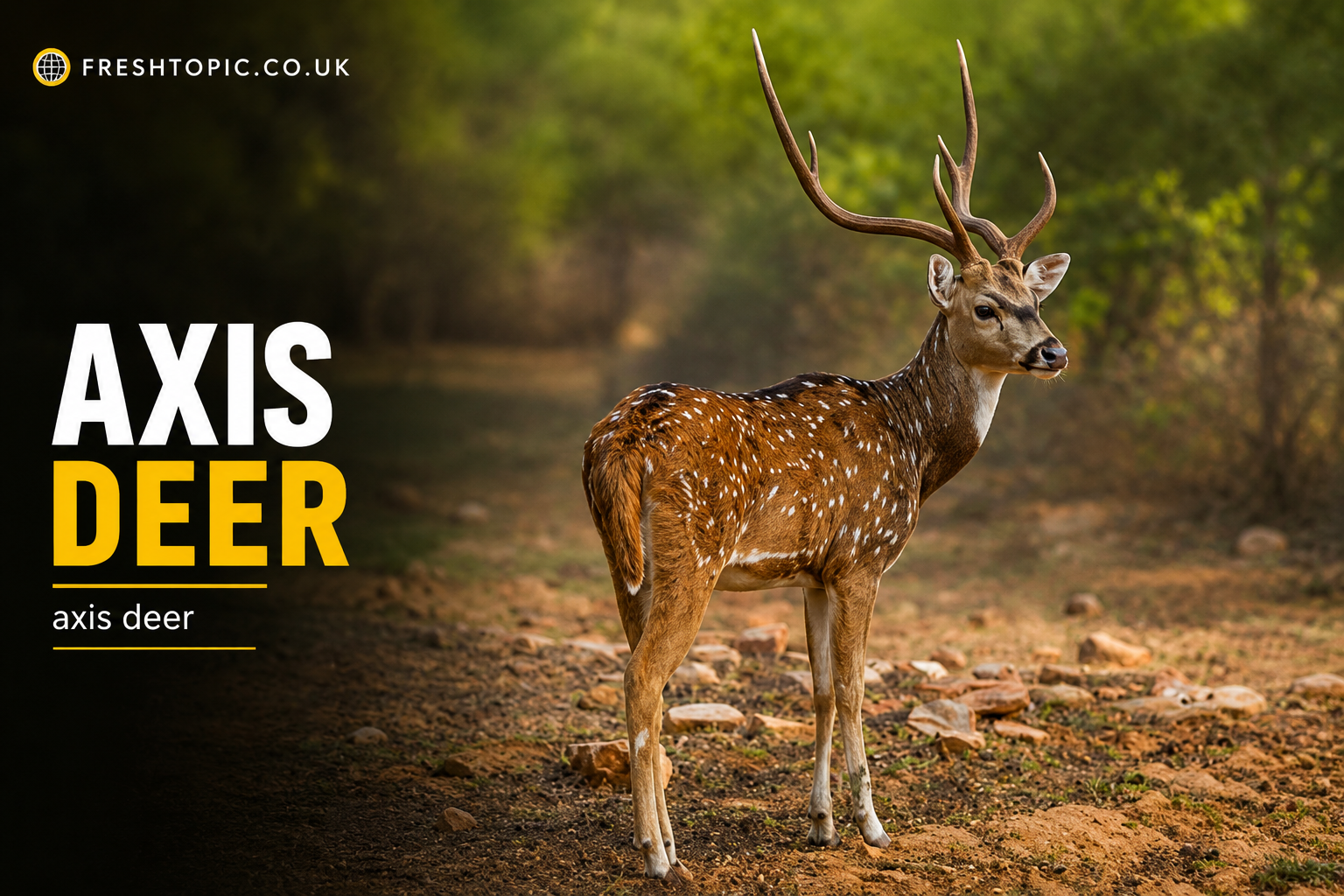
The axis deer’s (Axis axis), also called chital or spotted deer, is a medium-sized deer species native to the Indian subcontinent. It’s one of the most visually striking deer in the world, and that beauty is a big part of why humans kept moving it around the globe for over 150 years. & more blogs digital .
Key Physical Characteristics
- Coat: Reddish-gold with permanent white spots (unlike whitetail fawns, axis deer keep their spots for life)
- Size: Bucks typically weigh 150–250 pounds; does are noticeably smaller
- Antlers: Three points per side (six total), often exceeding 30–36 inches on mature bucks, grown and shed on an individual cycle rather than a synchronized season
- Behavior: Highly social, herding animals that graze grasses and browse shrubs, making them more adaptable eaters than native whitetail deer
- Vocalization: Bucks produce a loud, elk-like bugle during rut, which regularly surprises first-time hunters
Where Axis Deer Originally Come From
In their native range across India, Nepal, Sri Lanka, and Bangladesh, axis deer are a primary prey species for Bengal tigers. That predator pressure kept populations balanced for thousands of years. The problem started once humans introduced axis deer to places with no natural predators — which is exactly what happened in Hawaii and, later, Texas.
Close-up of an axis deer’s spotted coat and antlers | “axis deer spotted coat and antlers close-up”]
Axis Deer in Hawaii: An Ecological Crisis
This is the story most people are actually searching for when they type “axis deer’s hawaii” — and it’s more serious than most articles let on.
How Axis Deer Got to Hawaii
Axis deer’s were introduced to Hawaii as a gift, not an accident. Records show they were first brought to Molokai around 1868 as a gift to King Kamehameha V, then established on Lanai in the 1920s and on Maui in 1959 for recreational hunting. With no native predators and abundant vegetation, the population had nothing to stop it from growing.
Current Population Numbers
The numbers depend on the year and the source, but every recent estimate points the same direction: sharply upward.
- The Hawaii Department of Land and Natural Resources (DLNR) estimated roughly 26,000 axis deer across Maui Nui (Maui, Molokai, and Lanai) in 2025, with new surveys underway for 2026.
- Earlier state emergency declarations and independent reporting cited populations closer to 60,000 in Maui County alone during peak crisis years, with Molokai’s herd separately estimated in the tens of thousands relative to a human population of only about 7,000 residents.
- Whatever the exact figure in a given year, wildlife officials agree the deer-to-habitat ratio is unsustainable, which is why the state has repeatedly declared emergency proclamations for axis deer management.
The Environmental and Economic Damage
This isn’t a minor nuisance. Axis deer overbrowsing has been linked to:
- Stripped forest understories that normally capture rainwater and recharge Hawaii’s aquifers
- Increased soil erosion and runoff, which damages coral reefs downstream
- Faster spread of Rapid ʻŌhiʻa Death, a fungal disease devastating native ʻōhiʻa trees, as deer damage protective understory vegetation
- Direct agricultural losses, with some Maui farmers reporting decades of crop destruction dating back to the 1990s
- Vehicle collisions and residential yard damage as deer move into towns searching for food during droughts
In response, Hawaii’s DOFAW has launched a Landowner Incentive Program paying private landowners to increase deer removal, alongside fencing projects and community impact surveys running through 2026. It’s a rare case where wildlife management and conservation funding are being driven almost entirely by one invasive species.
Aerial photo of a large axis deer herd on Maui or Molokai | “axis deer herd Maui Hawaii invasive population”]
Axis Deer Hunting in Texas
Now for the flip side of the story: in Texas, axis deer’s aren’t a crisis — they’re a hunting industry.
Why Texas Has So Many Axis Deer
Axis deer’s were first brought to Texas ranches in the 1930s, primarily around the Edwards Plateau and Texas Hill Country, where dry scrub terrain and grazing-friendly land suited them well. Escapes from high-fenced ranches over the decades established large free-ranging populations. Texas now has an estimated 150,000+ axis deer, making it the largest population of the species outside of Hawaii and their native India.
Season, Licenses, and Rules
Here’s the detail hunters searching “axis deer’s hunting texas” actually want:
| Requirement | Detail |
|---|---|
| Hunting season | None — Texas Parks & Wildlife classifies axis deer as an exotic, non-game species, so they can be hunted year-round |
| Bag limits | None on most private land |
| License needed | A standard Texas hunting license; non-residents typically use a 5-day Special Hunting license |
| Best time to hunt | June–August, during peak rut, when more bucks carry hard antlers and bugle actively |
| Where | Overwhelmingly private, high-fenced or free-range ranches in the Hill Country, South Texas brush country, and West Texas |
Because axis deer’s are unregulated by state season structures, ranches control their own rules — always confirm bag limits and pricing directly with the outfitter.
What a Texas Axis Hunt Actually Looks Like
Most hunts happen on guided ranches ranging from a few hundred to tens of thousands of acres. Hunters typically use spot-and-stalk, ground blinds, or elevated stands, often combining an axis hunt with other exotics like aoudad or blackbuck available on the same property. Because axis deer’s are herd animals, seeing a group of 10–30 deer in open country isn’t unusual — the challenge is picking out a mature buck and getting a clean, ethical shot, not finding deer at all.
Expert Tip: Book axis hunts during the June–July rut if a trophy buck with hard antlers is the goal; book in cooler months if meat quality and comfort matter more than antler condition.
Hunter glassing for axis deer’s in Texas Hill Country terrain | Alt text: “axis deer hunting Texas Hill Country ranch”]
Axis Deer Meat: Nutrition, Taste, and Comparison
This is where axis deer’s wins over people who don’t hunt at all.
Axis Deer Meat vs. Beef vs. Standard Venison
| Metric (per 4 oz / ~113g cooked) | Axis Deer Meat | Standard Venison | 80/20 Ground Beef |
|---|---|---|---|
| Calories | ~120 | ~150–170 | ~290 |
| Fat | ~1.9g | ~2–3g | ~20g |
| Protein | High, lean | ~28–30g | ~19g |
| Cholesterol | Low | Low-moderate | Higher |
| Flavor profile | Mild, not “gamey” | Mild to moderately gamey | Rich, fatty |
Wild game processors and Texas Parks & Wildlife data consistently point to the same conclusion: axis deer’s meat is exceptionally lean, with roughly comparable fat content to a skinless chicken breast, while retaining the iron and B-vitamin density typical of red meat.
How It Tastes and How to Cook It
Because axis deer’s graze on grasses rather than a heavy browse-based diet, their meat is widely considered milder and less “gamey” than whitetail or mule deer venison — one reason chefs and wild-game companies market it as an entry point for people who think they don’t like venison.
Cooking recommendations:
- Because it’s so lean, avoid overcooking — medium-rare to medium is ideal for steaks and backstrap
- Marinate roasts briefly in acid (citrus or vinegar-based) to add moisture, not to mask flavor
- Ground axis venison works well blended with a small amount of beef fat or pork fat for burgers, since it has almost none of its own
Plated axis venison steak with a simple herb garnish | Alt text: “axis deer meat venison steak plated”]
Pros and Cons of Axis Deer
| Pros | Cons |
|---|---|
| Exceptionally lean, mild-tasting meat | Devastating invasive impact in Hawaii’s native ecosystems |
| Year-round hunting opportunity in Texas | Contributes to erosion, reef damage, and disease spread in Hawaii |
| Disease-resistant, hardy species | Competes with native whitetail and livestock for forage |
| Supports a growing wild-game meat industry | Population control is expensive and politically complex |
| Beautiful, distinctive trophy animal for hunters | Vehicle collisions and property damage in populated areas |
Why This Matters
Axis deer’s sit at the intersection of three issues a lot of readers care about: sustainable, ethical meat sourcing; the economics and ethics of hunting; and how a single well-intentioned wildlife introduction decades ago can spiral into a full-blown conservation crisis. Understanding axis deer’s means understanding a broader pattern that plays out with invasive species worldwide — an animal that’s a genuine resource in one region can simultaneously be an ecological liability in another. That tension is exactly why axis deer keep showing up in hunting forums, nutrition blogs, and Hawaii news coverage all at once.
Expert Recommendations
- For hunters: Book Texas axis hunts through outfitters with verifiable references and clear, written terms on trophy fees versus day rates — pricing structures vary widely between ranches.
- For home cooks: Start with axis backstrap or tenderloin cuts before attempting a full roast; they’re the most forgiving cuts for a first-time venison cook.
- For Hawaii residents and landowners: Engage directly with DLNR’s Landowner Incentive Program and impact surveys if axis deer affect your property — state agencies are actively using this feedback to shape management policy.
- For conservation-minded readers: Support wild-game meat companies that source ethically harvested invasive-species venison, since consumer demand directly funds population control efforts in Hawaii.
Mistakes to Avoid
- Assuming axis deer season rules match whitetail rules in Texas. They don’t — there’s no closed season or bag limit on most private land, but individual ranches set their own limits.
- Overcooking the meat. Its low fat content means it dries out fast past medium doneness.
- Underestimating Hawaii’s population data. Numbers vary by source and year; always check the most recent DLNR estimate rather than repeating outdated crisis-era figures.
- Ignoring shot placement on herd animals. Because axis deer travel in groups, rushed shots are a common ethical hunting mistake — patience in identifying a specific mature buck matters more than with solitary game.
- Confusing axis deer with sika deer or fallow deer. All three are spotted exotic species in the U.S., but they differ in antler structure, size, and native range.
Conclusion
Axis deer’s are a genuinely rare case: the same animal is simultaneously an ecological emergency and a prized game and food resource, depending entirely on where it’s standing. Whether you came here because Maui’s forests worry you, because you’re planning a Texas hunt, or because you’re curious whether the meat lives up to the hype, the throughline is the same — this is an adaptable, hardy species that thrives wherever humans put it, for better or worse.
If you’re considering a Texas axis hunt, start by contacting a licensed outfitter and asking about June–August rut timing. If you’re curious about the meat, look for reputable wild-game suppliers sourcing from managed Hawaii or Texas harvests. And if you live in Hawaii and axis deer are affecting your land, Hawaii’s DLNR is actively looking for community input right now
FAQs
What is an axis deer?
An axis deer’s, also called chital, is a spotted deer species native to India and South Asia, known for its reddish-gold coat, permanent white spots, and three-point antlers per side.
Why are there so many axis deer in Hawaii?
Axis deer’s were introduced to Hawaii in the 1860s and expanded rapidly because the islands have no natural predators like tigers to control their numbers, combined with abundant year-round vegetation.
How many axis deer are in Hawaii right now?
State wildlife officials estimated roughly 26,000 axis deer across Maui, Molokai, and Lanai combined in 2025, though populations have been reported far higher during past emergency periods; new 2026 survey data is being collected.
Is axis deer hunting legal year-round in Texas?
Yes. Texas Parks & Wildlife classifies axis deer as an exotic, non-game species, meaning there is no closed season or statewide bag limit on private land.
Do I need a special license to hunt axis deer in Texas?
Residents typically use a standard Texas hunting license; non-resident hunters commonly use a 5-day Special Hunting license, which is inexpensive compared to licenses for native big game.
Is axis deer meat healthy to eat?
Yes — axis deer’s meat is exceptionally lean, with roughly 1.9 grams of fat and about 120 calories per 4-ounce serving, making it comparable to skinless chicken breast in fat content while retaining red-meat levels of iron and B vitamins.
Does axis deer meat taste gamey?
Less so than most venison. Because axis deer’s are primarily grazers rather than heavy browsers, their meat is widely described as mild and approachable, even for people who dislike traditional venison.
Can you hunt axis deer outside of Texas and Hawaii?
Free-ranging and ranch populations also exist in states like Florida and Georgia in smaller numbers, though Texas remains the dominant U.S. hunting destination.
In Short
- Axis deer are a spotted, Indian-origin deer species now firmly established in both Hawaii and Texas, for very different reasons.
- In Hawaii, axis deer are an invasive species causing serious ecological and agricultural damage, with population estimates in the tens of thousands across Maui Nui.
- In Texas, axis deer are a legal, year-round exotic game species supporting a major hunting industry across the Hill Country and beyond.
- Axis deer meat is exceptionally lean and mild-tasting, often compared favorably to chicken in fat content and to premium beef in nutrient density.
- Responsible hunting and consumer demand for wild-harvested axis venison are actively part of Hawaii’s population management strategy.