









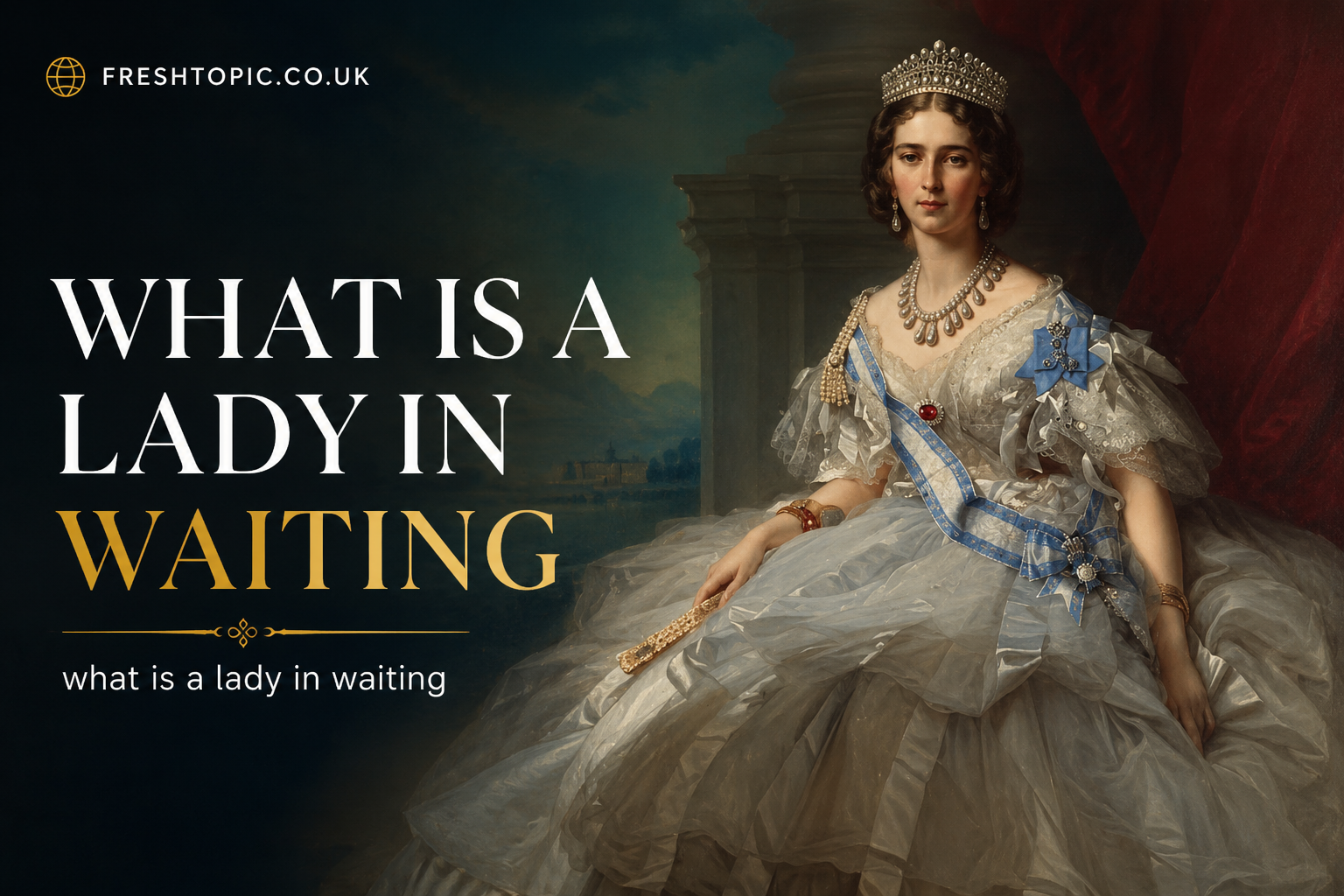
You’ve heard the phrase in a period drama, seen it in a royal headline, or watched Queen Charlotte’s inner circle glide across the screen in matching white gowns on Bridgerton — and now you actually want a straight answer. What is a lady in waiting , really?
Here’s the confusing part: the answer isn’t the same today as it was 50 years ago, and it isn’t the same in real life as it is on Netflix. The term gets used loosely, the role has quietly changed inside the actual British royal household, and most explanations online either oversimplify it or repeat outdated information from before King Charles III’s reign began.
This guide fixes that. Below, you’ll get the real historical meaning, what the job involves today, how the royal household modernized the role, and exactly how Bridgerton’s fictional version compares to reality — all in one place, without the fluff.What Is a Lady in Waiting .
What Is a Lady in Waiting ? (Quick Definition)
A lady in waiting is a woman who personally attends and assists a queen, princess, or other high-ranking noblewoman, historically as a paid or honorary position within a royal court. She acts as a companion, personal assistant, and social gatekeeper rolled into one — helping with everything from correspondence and event planning to simply providing trusted company.
A lady in waiting is a female attendant, traditionally of noble or aristocratic birth, who serves and accompanies a queen or royal woman, handling personal, social, and sometimes administrative duties on her behalf. & more blogs digital .
Where the Term Comes From
The role dates back to medieval European royal courts, where a queen’s personal staff came almost exclusively from aristocratic families. Serving as a lady in waiting wasn’t considered a job in the modern sense — it was a position of status, trust, and proximity to power, and it often came with real political influence behind the scenes.
Illustration or portrait of a historic European royal court scene | “medieval lady in waiting royal court illustration”]
What is a Lady in Waiting Actually Do?
Historical Duties
For centuries, a lady in waiting’s responsibilities included:
- Helping the queen dress, bathe, and prepare for public appearances
- Managing personal (non-state) correspondence
- Organizing the queen’s daily schedule and social calls
- Acting as a chaperone or companion during travel and events
- Serving, at times, as an informal advisor or trusted confidante
Because these women lived in close proximity to the monarch, many became deeply entangled in court politics — a pattern historians point to repeatedly across European royal history.
Modern Duties
Today, the role looks far less glamorous and far more administrative. Modern ladies in waiting (where the position still exists) typically:
- Accompany royal women to public engagements
- Assist with gifts, thank-you notes, and non-state correspondence
- Provide personal companionship and support during long royal tours
- Help manage logistics around events and appearances
One detail that surprises most people: the role has traditionally been unpaid and, in many cases, a lifelong honorary appointment rather than a salaried job — though expenses are typically covered.
Expert Tip: If you’re researching this for historical writing or fiction, don’t confuse a lady in waiting with a lady’s maid. A lady’s maid was a domestic servant handling physical tasks; a lady in waiting was a social and companionate role, usually filled by someone of equal or near-equal social standing.
What Is a Lady in Waiting to the Queen?
This is where most articles get outdated fast — because the real-life role has changed significantly in the last few years.
Queen Elizabeth II’s Ladies-in-Waiting
During her 70-year reign, Queen Elizabeth II had a rotating group of ladies-in-waiting who assisted her with correspondence, accompanied her on tours, and supported her at official engagements. It was a well-established, centuries-old tradition by the time of her death in 2022.
Why Queen Camilla Doesn’t Have “Ladies-in-Waiting” Anymore
Here’s the update most people searching this term don’t know yet: when Camilla became Queen Consort (and later simply “Queen”) after King Charles III’s accession, Buckingham Palace announced she would not have traditional ladies-in-waiting at all. Instead, her close support circle was rebranded as “Queen’s Companions.”
The new role is intentionally more informal than the old one. Queen’s Companions:
- Are unpaid, honorary appointees (expenses covered, no salary)
- Attend fewer events than traditional ladies-in-waiting did
- Are not responsible for administrative tasks or official correspondence
- Include longtime friends of Camilla’s, such as Sarah Troughton and the Marchioness of Lansdowne
Meanwhile, Queen Elizabeth II’s former ladies-in-waiting weren’t dismissed — those who chose not to retire were kept on as part of the royal household under a new title: “Ladies of the Household,” helping King Charles host events at Buckingham Palace.
Lady in Waiting vs. Queen’s Companion
| Feature | Traditional Lady-in-Waiting | Queen’s Companion (Camilla, 2022–present) |
|---|---|---|
| Introduced | Medieval era | 2022, under King Charles III |
| Compensation | Unpaid, expenses covered | Unpaid, expenses covered |
| Appointment length | Often lifelong | Informal, ongoing |
| Handles correspondence | Yes | No |
| Attends events | Frequently | Occasionally |
| Administrative duties | Yes | No |
Featured answer: A lady in waiting to the Queen historically handled correspondence, scheduling, and companionship for the monarch. Under King Charles III, this role was replaced for Queen Camilla with a more informal position called “Queen’s Companion,” which involves fewer duties and less frequent appearances.
Queen Camilla at a public engagement with her support team | Alt text: “queen camilla queens companions royal engagement”]
What Is a Lady in Waiting in Bridgerton?
Netflix’s Bridgerton has introduced an entirely new audience to this term — and for good reason. In the show, Queen Charlotte’s ladies-in-waiting are aristocratic women who serve as her closest attendants, appearing at court in coordinated, elegant white gowns and acting as her eyes and ears within London’s social scene, known as the ton.
The Role in the Show
In Bridgerton, being a lady-in-waiting to Queen Charlotte is portrayed as one of the most coveted (and competitive) positions in high society. The role comes with real influence: proximity to the Queen means access to gossip, favor, and social protection. In Season 4, this plays out directly when Lady Danbury works to secure a suitable lady-in-waiting for Queen Charlotte before Danbury can travel abroad — with Alice Mondrich emerging as a candidate for the position.
How Accurate Is Bridgerton’s Version?
Bridgerton takes real historical inspiration and dramatizes it. The show’s ladies-in-waiting reflect the genuine historical reality that these women were typically aristocrats, that the role carried social prestige and rivalry, and that proximity to a monarch translated into real influence. Where the show takes creative liberties is in the heightened drama, the visual uniformity (matching gowns), and compressing years of court politics into fast-paced television plotlines.
Bridgerton’s Queen Charlotte with her ladies-in-waiting in white gowns | Alt text: “Bridgerton lady in waiting Queen Charlotte white gowns”]
Pros and Cons of Being a Lady in Waiting
| Pros | Cons |
|---|---|
| Historically prestigious and socially influential position | Traditionally unpaid, despite significant time commitment |
| Close personal relationship with a monarch or royal | Often a lifelong appointment with limited flexibility |
| Access to court life, travel, and major state events | Limited personal privacy and independence |
| Modern version (Queen’s Companion) is less demanding | Historically entangled in court intrigue and rivalry |
| Featured prominently in popular culture (Bridgerton, The Crown) | Role’s real-world significance has diminished over time |
Why This Matters
The lady-in-waiting role is a useful lens for understanding how monarchies evolve without fully disappearing. It shows how deeply personal, centuries-old traditions get renegotiated for modern sensibilities — unpaid labor, gendered court roles, and rigid social hierarchy don’t map cleanly onto 21st-century expectations. Understanding the shift from “lady-in-waiting” to “Queen’s Companion” also explains a broader trend: the British monarchy has been quietly modernizing many of its internal roles since 2022, and this is one of the clearest, most publicly documented examples.
Expert Recommendations
- If you’re researching for historical or academic writing: Distinguish clearly between medieval-era ladies-in-waiting, Queen Elizabeth II’s 20th-century version, and the post-2022 “Queen’s Companion” role — conflating them creates factual errors.
- If you’re a Bridgerton fan wanting historical context: Read about real Georgian-era court attendants to see which details the show dramatizes versus which it plays straight.
- If you’re writing fiction involving a royal court: Give your lady-in-waiting character a clear social rank relative to the monarch — this single detail shapes how much narrative influence and constraint she realistically has.
- If you’re following current royal news: Use “Queen’s Companion” when referring to Camilla’s support circle and “Ladies of the Household” for Queen Elizabeth II’s former attendants — using “lady-in-waiting” for either is now technically outdated.
Common Mistakes and Misconceptions
- Assuming Queen Camilla has ladies-in-waiting. She doesn’t — the role was replaced with “Queen’s Companions” in 2022.
- Confusing a lady in waiting with a lady’s maid. One is a social companion role; the other is domestic service.
- Assuming the position is or was salaried. It has traditionally been unpaid and honorary, with expenses covered.
- Treating Bridgerton’s portrayal as historically literal. The show is inspired by real court dynamics but dramatizes and compresses them for television.
- Using the term as if it only applies to British royalty. Similar roles have existed across European, and some non-European, royal courts throughout history.
Conclusion
So, what is a lady in waiting? At its core, it’s a centuries-old role built on trust, proximity to power, and personal service to a monarch — one that has quietly transformed in real life even as it’s become more visible in pop culture through shows like Bridgerton. The historical version, Queen Elizabeth II’s version, and today’s “Queen’s Companion” role are three distinct chapters of the same tradition, and knowing the difference means you’ll actually understand the term the next time it shows up in a headline or a period drama.
If you’re a royal history enthusiast or a Bridgerton fan trying to separate fact from fiction, hopefully this cleared up exactly where the line sits.
FAQs
What is a lady in waiting?
A lady in waiting is a female attendant, traditionally of noble birth, who serves as a companion and personal assistant to a queen or other royal woman, handling social, personal, and historically administrative duties.
What does lady in waiting mean in simple terms?
It means a trusted personal companion and helper to a royal woman — similar in spirit to a modern chief of staff and close friend combined, though historically unpaid.
What is a lady in waiting to the Queen today?
Under King Charles III, Queen Camilla does not have traditional ladies-in-waiting; her support circle is now called “Queen’s Companions,” a more informal, less administrative version of the historic role.
Is being a lady in waiting a paid job?
No. The role has traditionally been unpaid and honorary, though expenses are typically covered by the royal household.
What is a lady in waiting in Bridgerton?
In Bridgerton, a lady-in-waiting is one of Queen Charlotte’s closest attendants, chosen from aristocratic society, who accompanies her at court and helps manage her social and personal affairs within the show’s fictional Regency-era London.
Do princesses have ladies-in-waiting too?
Historically, yes — many royal women beyond the reigning queen, including princesses and duchesses, have had their own attendants, though the scale and formality vary by royal house and era.
Why did the British royal family change the lady-in-waiting role?
Buckingham Palace described the change as part of a broader effort to modernize the monarchy under King Charles III, reducing the formality, administrative load, and lifelong obligation associated with the traditional role.
What’s the difference between a lady in waiting and a chaperone?
A chaperone’s role is narrowly focused on supervision and propriety, usually temporary; a lady in waiting has a broader, ongoing role encompassing companionship, logistics, and social duties over a much longer period.
In Short
- A lady in waiting is a companion and personal attendant to a queen or royal woman, traditionally drawn from the aristocracy and unpaid.
- Queen Elizabeth II maintained the traditional lady-in-waiting role throughout her 70-year reign.
- Since 2022, Queen Camilla’s support circle uses the modernized title “Queen’s Companion,” with fewer and less formal duties.
- Elizabeth II’s former ladies-in-waiting are now known as “Ladies of the Household” within King Charles III’s royal household.
- Bridgerton’s version of the role draws on real historical dynamics but dramatizes them for entertainment, including the show’s Season 4 storyline around finding a new lady-in-waiting for Queen Charlotte.