











You’ve probably heard the phrase “it’s my right” a hundred times — in arguments, in news headlines, in the Constitution itself. But have you ever stopped to ask where rights actually come from?
Here’s the problem: most people confuse natural rights with rights granted by government, and that confusion has real consequences — it shapes how we vote, how we argue about freedom, and how we understand the founding documents of nations like the United States.
The curiosity hook is this: the idea that you were born with rights nobody can legally erase — not a king, not a president, not a parliament — is one of the most radical ideas in human history. It toppled monarchies and built democracies.
The pain point? Textbooks throw around terms like “natural right’s,” “John Locke,” and “unalienable rights” without ever clearly explaining what they mean or why they still matter today.
This guide fixes that. By the end, you’ll have a clear, citable natural rights definition, a breakdown of John Locke’s natural rights theory, concrete natural rights examples, and the tools to explain this concept with confidence — whether you’re a student, writer, debater, or just a curious mind.
What Are Natural Rights? (Clear Definition)
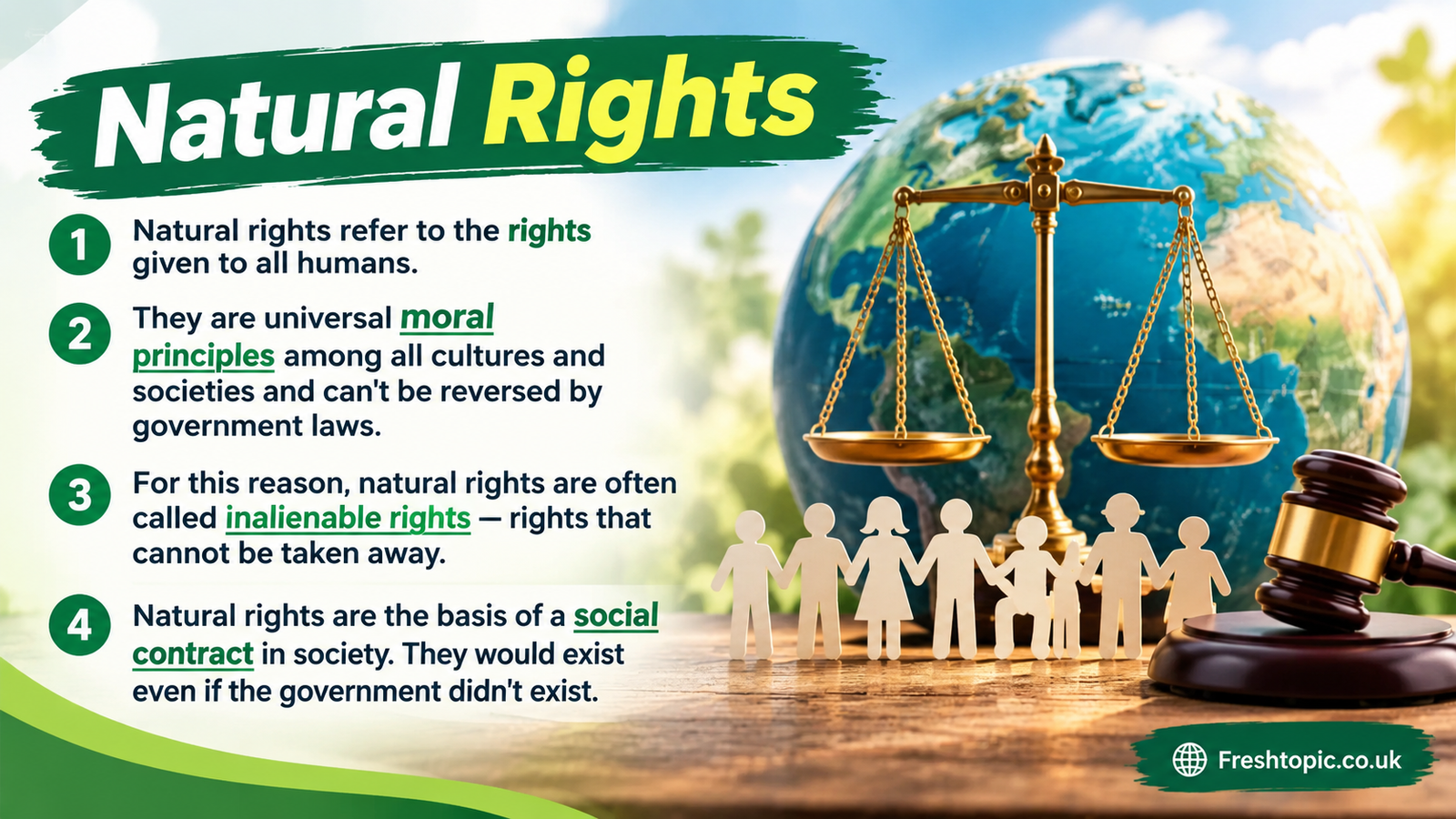
Natural rights definition: Natural right’s are moral entitlements that every human being possesses simply by virtue of being human — not because a government, ruler, or law grants them. They exist independently of any legal system and cannot be legitimately taken away, though history shows they can certainly be violated.
Unlike privileges handed out by a monarchy or benefits created by legislation, natural right’s are considered inherent, universal, and inalienable. & more blogs neural .That means:
- Inherent — you’re born with them, not given them.
- Universal — they apply to all people, everywhere, regardless of nationality or government.
- Inalienable — they cannot be transferred, sold, or legitimately revoked.
Natural Rights vs. Legal Rights vs. Civil Rights
People often mix these three up. Here’s the distinction in plain English:
| Concept | Source | Example | Can Be Revoked? |
|---|---|---|---|
| Natural rights | Human nature / moral philosophy | Right to life, liberty | No — only violated |
| Legal rights | Statutes and laws passed by government | Right to a driver’s license | Yes |
| Civil rights | Constitutional and legislative protections | Right to vote, equal protection | Yes (through legal process) |
Natural right’s come from human nature itself; legal and civil rights come from government and can be changed or repealed.
The Origin of Natural Rights: A Brief History
The theory of natural right’s didn’t appear overnight — it developed over centuries through philosophy, religion, and law.
Ancient and Enlightenment Roots
Early natural law thinking traces back to Stoic philosophers in ancient Greece and Rome, who argued that a universal moral order governs all people. Medieval thinkers like Thomas Aquinas later connected this idea to divine law.
But the modern concept of “natural right’s” as individual entitlements crystallized during the Enlightenment in the 1600s–1700s, thanks largely to philosophers like Thomas Hobbes, Hugo Grotius, and — most famously — John Locke.
John Locke and Natural Rights
If natural right’s theory has a single most influential author, it’s John Locke, the 17th-century English philosopher. Locke argued that in a “state of nature” — before governments existed — people already possessed certain rights simply by being human.
Locke’s Three Core Natural Rights
Locke identified three foundational natural right’s:
- Life — the right to exist and not be arbitrarily killed.
- Liberty — the right to act freely, as long as you don’t harm others.
- Property — the right to own the product of your own labor.
Locke’s core argument: governments are not the source of these rights — they exist to protect them. If a government fails to protect these rights, Locke argued, citizens have the right to resist or replace it.
How Locke Influenced the U.S. Declaration of Independence
Locke’s fingerprints are all over America’s founding documents. Thomas Jefferson adapted Locke’s “life, liberty, and property” into the now-famous phrase:
“Life, Liberty, and the pursuit of Happiness.”
This wasn’t a coincidence — Jefferson and the other Founders had studied Locke’s Two Treatises of Government closely, and it directly shaped the philosophical backbone of the Declaration of Independence in 1776.
Natural Rights Examples in Everyday Life
Abstract philosophy is easier to grasp with concrete examples. Here are common natural right’s examples:
- Right to life — protection from being unjustly killed.
- Right to liberty — freedom of movement, speech, and belief.
- Right to property — ownership of what you build, earn, or create.
- Right to self-defense — protecting your life and safety from harm.
- Right to conscience — freedom to hold your own beliefs and religion.
Natural Rights in Modern Law and Constitutions
Modern legal systems often try to codify natural rights so they’re formally protected:
- The U.S. Bill of Rights protects speech, religion, and due process.
- The UN Universal Declaration of Human Rights (1948) echoes natural right’s language, describing rights as “inherent to all human beings.”
- Many national constitutions reference “inalienable” or “inherent” rights directly.
Expert tip: When analyzing any constitution, ask whether a right is described as something the government grants or something it recognizes. That single word often reveals whether the framers were thinking in natural-right’s terms.
Natural Rights vs. Positive Rights (Comparison Table)
| Feature | Natural Rights | Positive Rights |
|---|---|---|
| Origin | Human nature | Government/society |
| Examples | Life, liberty, property | Right to education, healthcare |
| Requires action from others? | No (freedom from interference) | Yes (requires resources/services) |
| Universality | Same for everyone, everywhere | Varies by country/policy |
| Can be legislated away? | No (only violated) | Yes |
Pros and Cons of Natural Rights Theory
Pros:
- Provides a moral foundation for resisting tyranny.
- Justifies limits on government power.
- Underpins modern human right’s frameworks.
Cons:
- Critics argue there’s no empirical proof rights exist “in nature.”
- Different philosophers disagree on which rights count as “natural.”
- Can be used selectively to justify conflicting political agendas.
Common Mistakes People Make About Natural Right
- Confusing natural right’s with legal rights — assuming all rights come from government.
- Assuming natural rights are unlimited — Locke himself said liberty ends where it harms others.
- Thinking natural rights guarantee outcomes — they protect freedom from interference, not guaranteed results (that’s a positive right).
- Ignoring historical context — applying 17th-century property theory without nuance to modern debates.
Why This Matters
Understanding natural right’s isn’t just academic trivia — it’s the philosophical foundation behind:
- Constitutional limits on government power.
- Modern human rights law and international treaties.
- Ongoing debates about civil liberties, bodily autonomy, and free speech.
When you understand why rights are framed as natural rather than granted, you understand why courts, activists, and lawmakers argue so fiercely over their scope — because the stakes are about the legitimacy of power itself.
Expert Recommendations
- For students: Read Locke’s Second Treatise of Government (Chapter II, “Of the State of Nature”) for the primary source.
- For debaters: Distinguish natural right’s arguments from utilitarian or legal-positivist arguments — they answer different questions.
- For policy writers: When drafting rights-based arguments, clarify whether you’re invoking a natural right’s (inherent) or a positive right (provided) — this avoids confused, mixed reasoning.
Conclusion
Natural right’s are the invisible architecture behind some of history’s biggest political revolutions — including the one that created the United States. They remind us that freedom isn’t a gift from the powerful; it’s a starting condition of being human that governments are meant to protect, not create.
Now that you understand the definition, John Locke’s foundational theory, and concrete examples, you’re equipped to spot natural-right’s reasoning anywhere it shows up — from courtrooms to classrooms to protest signs.
FAQs
What is the simplest definition of natural right’s?
Natural right’s are rights every person has simply by being human, independent of any government or law.
What are John Locke’s three natural right’s?
Life, liberty, and property.
Are natural rights the same as human right’s?
They’re closely related. Human right’s, as codified in documents like the UN Declaration, are largely built on natural rights theory, but human right’s are formally written into international law, while natural right’s exist independent of any law.
Can natural right’s be taken away?
They cannot be legitimately taken away, but they can be violated or suppressed by unjust governments.
Who came up with the idea of natural right’s?
While roots trace to ancient Stoic and natural law philosophy, the modern individual-rights version is most associated with John Locke in the 17th century.
Why are natural right’s called “unalienable”?
Because they are considered inseparable from being human — no person or government can legitimately transfer or revoke them, a term famously used in the U.S. Declaration of Independence.
In Short
- Natural right’s exist independently of government and cannot be legitimately revoked.
- John Locke’s theory of life, liberty, and property heavily influenced the U.S. Declaration of Independence.
- Natural right’s differ from legal and positive rights, which are created and can be changed by governments.
- Real-world examples include the right to life, liberty, property, self-defense, and conscience.
- Confusing natural right’s with granted rights is one of the most common conceptual errors in political discussions.