









You’ve seen the word “naginata” pop up somewhere — maybe in a samurai film, a martial arts documentary, or while farming weapons in Elden Ring’s Caelid region — and you’re still not entirely sure what it actually is. A sword? A spear? Something else entirely?
That confusion is common, and honestly, understandable. The naginata gets lumped in with katanas in casual conversation, misrepresented in games and pop culture, and rarely explained with real historical context. If you’ve searched “naginata sword” hoping for a straight answer, most results either oversimplify it or bury the useful information under SEO fluff.
This guide fixes that. You’ll get a clear, accurate breakdown of what a naginata actually is, how it compares to a katana and a spear, its surprising connection to Japan’s female warrior class, how it’s still trained today, and — since a lot of searches for this term come from gamers — a full explanation of the Cross-Naginata in Elden Ring, including exactly where to find it and how to build around it.
What Is a Naginata?
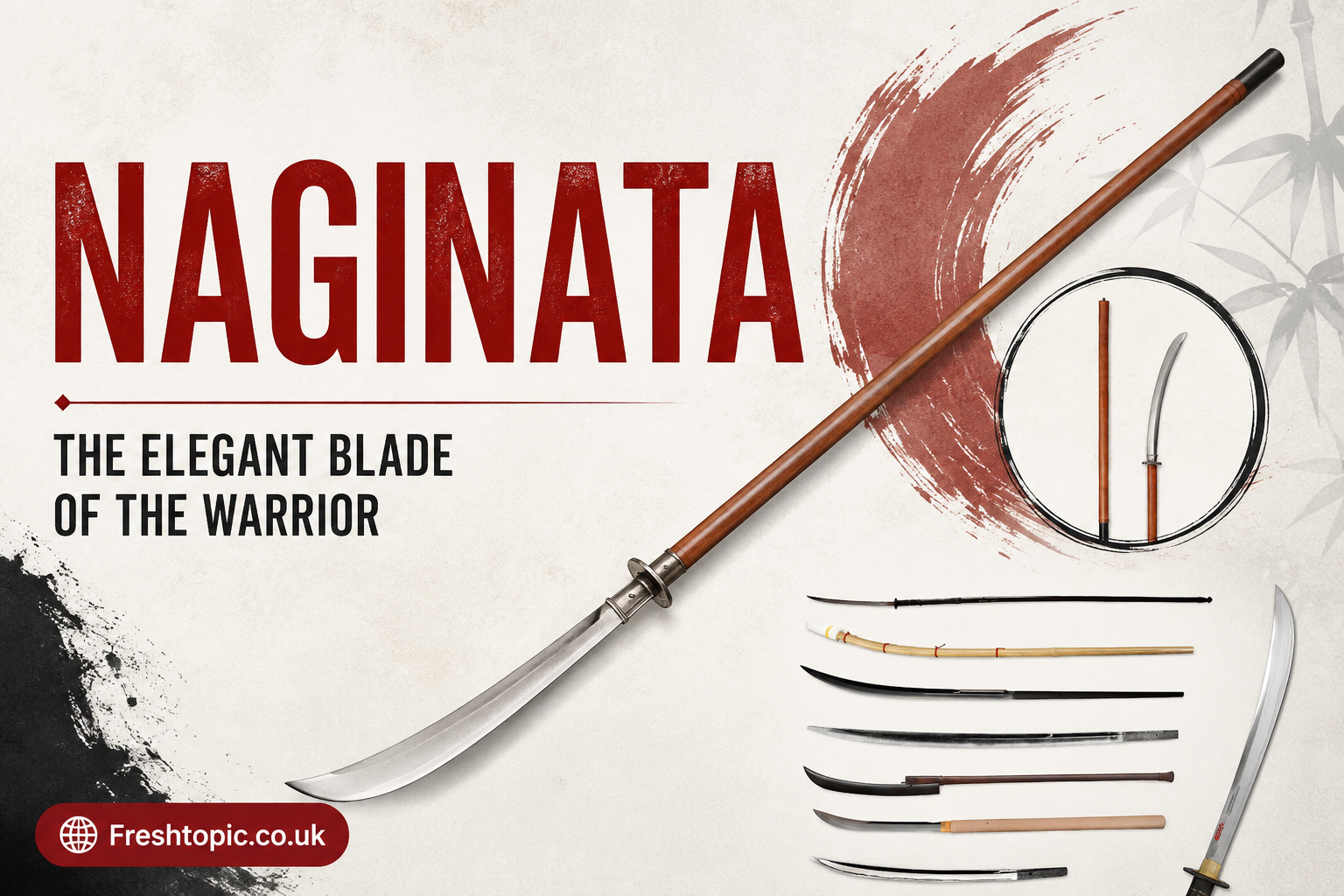
A naginata is a traditional Japanese polearm consisting of a curved, single-edged blade mounted on a long wooden shaft, historically used by samurai and warrior monks for both slashing and thrusting attacks.
The name “naginata” is generally translated as “mowing blade” or “reaping sword,” a reference to its sweeping cutting motion, which some historians trace back to earlier agricultural tools with a similar blade-on-pole design.
Is a Naginata a Sword?
Not exactly — and this is where most confusion starts. A naginata is technically classified as a polearm, not a sword, because its blade is mounted on a long shaft rather than a short handle. That said, the blade itself is forged using traditional Japanese swordsmithing techniques, and in some historical and legal contexts (including certain modern Japanese sword-registration laws), a naginata blade is treated similarly to a sword blade. So while “naginata sword” is a common search phrase, the more accurate description is “sword-bladed polearm.” & more blogs to see digital .
Naginata Design and Anatomy
A traditional naginata’s has three main components:
- Ha (blade) — a curved, single-edged blade, typically 1–2 feet long
- Nakago (tang) — the section of the blade secured inside the shaft
- Ei/Tsuka (shaft) — a long wooden pole, often 4–6 feet, sometimes fitted with metal rings or a butt-cap for balance and durability
This combination gave the naginata’s serious reach advantages over a katana, while still allowing for the slashing techniques samurai were already trained in.
The History of the Naginata
Origins on the Battlefield
The naginata’s rose to prominence in Japan between the Heian and Kamakura periods (roughly the 8th through 14th centuries), when it was prized for its reach and versatility against both infantry and mounted opponents. Warrior monks (sōhei) were especially known for wielding naginata to defend temple grounds, and the weapon remained a staple of Japanese battlefield combat for centuries before firearms and more compact weapons gradually changed battlefield tactics.
The Naginata and Warrior Women (Onna-Musha)
One of the most historically significant associations with the naginata’s is its role as a signature weapon for onna-musha, women of Japan’s samurai class trained in combat to defend their households and communities. The naginata’s reach made it particularly effective for a defender who needed to keep an armed, often larger opponent at a distance, which contributed to its long-standing association with women’s martial training in samurai society — a tradition that carries directly into how the weapon is taught today.
Naginata vs. Other Japanese Weapons
Naginata vs. Katana
| Feature | Naginata | Katana |
|---|---|---|
| Classification | Polearm | Sword |
| Blade length | 1–2 feet | 2–3 feet |
| Overall length | 4–7 feet | 3–4 feet |
| Primary technique | Sweeping slashes, thrusts, reach control | Close-range cutting and drawing techniques |
| Historical users | Samurai, warrior monks, onna-musha | Samurai, primarily in close combat |
Naginata vs. Yari (Spear)
The naginata’s is often confused with the yari, Japan’s traditional straight spear, but the two are built for different jobs. A yari has a straight, symmetrical blade optimized almost entirely for thrusting, while a naginata’s curved blade allows for both cutting and thrusting techniques — making it a more versatile, if slightly less specialized, battlefield weapon.
Naginatajutsu: The Martial Art of the Naginata
The traditional martial art built around this weapon is called naginatajutsu (or modern “atarashii naginata” in its contemporary sport form). It remains an actively practiced martial art in Japan today, with structured forms (kata), sparring competitions using padded practice weapons, and a governing federation that oversees standardized rules and rankings.
How Naginata Training Works Today
- Kihon (basics) — students learn fundamental stances, grips, and striking patterns before any sparring.
- Kata (forms) — pre-set sequences practiced with a partner to build muscle memory and timing.
- Shiai (competitive sparring) — practiced with a padded naginata (often called a “hakuda” or foam-tipped training weapon) and protective armor similar to kendo gear.
- Grading and ranking — practitioners advance through kyu and dan ranks, similar to other Japanese martial arts systems.
Naginatajutsu is practiced by both men and women today, but it retains a particularly strong association with women’s martial arts programs in Japan, a direct continuation of its historical roots.
The Cross-Naginata in Elden Ring
If you landed here searching “cross naginata elden ring,” here’s the direct answer.
The Cross-Naginata’s is a Spear-class weapon in Elden Ring featuring a three-pronged, katana-like blade on a long shaft. It scales with both Strength and Dexterity, has an innate Bleed (Hemorrhage) buildup effect, and is found on a corpse inside Gael Tunnel in Caelid.
How to Get the Cross-Naginata
To pick up the Cross-Naginata’s, head to Gael Tunnel, located in Caelid near the Rotview Balcony Site of Grace. The weapon rests on a corpse inside a cavern area where a Giant Land Octopus hangs from the ceiling — you do not need to defeat any bosses or enemies to grab it, making it one of the more accessible early-game Bleed weapons in the game.
Cross-Naginata Stats and Scaling
- Weapon type: Spear
- Damage type: Slash/Pierce, with innate Hemorrhage (Bleed) buildup
- Stat requirements: Strength 16, Dexterity 20
- Scaling at +25 (Standard affinity): Dexterity B, Strength D
- Default Ash of War: Impaling Thrust, a lunging thrust attack capable of piercing through enemy shields
Best Builds for the Cross-Naginata
- Dexterity/Bleed builds — the Cross-Naginata’s biggest strength is its innate Bleed buildup, which can be enhanced further with the Blood affinity (using a Black Whetblade) or talismans like Lord of Blood’s Exultation.
- Quality builds — because it scales with both Strength and Dexterity, it works reasonably well as a flexible early-to-mid-game option before switching to a more specialized weapon later.
- Status-stacking builds — pairing it with elemental Ashes of War (such as Chilling Mist or Poisonous Mist) allows players to stack Bleed alongside Frostbite or Poison for layered status damage.
Pros and Cons of the Naginata as a Weapon
| Pros | Cons |
|---|---|
| Excellent reach compared to swords | Requires more open space to use effectively |
| Versatile slashing and thrusting capability | Historically less effective in tight indoor combat |
| Strong historical and martial arts legacy | Modern practice requires specialized training and equipment |
| Recognized, accessible early weapon in games like Elden Ring | In-game version is a below-average pure physical weapon without a Bleed build focus |
Mistakes to Avoid When Researching or Training With a Naginata
- Calling it a sword outright. It’s more accurate to describe it as a polearm with a sword-forged blade — an important distinction for historical accuracy.
- Confusing it with a yari. The curved, cutting-capable blade is what separates a naginata from Japan’s straight thrusting spear.
- Assuming naginatajutsu is purely historical. It’s an actively practiced, federated modern martial art, not just a museum-piece tradition.
- In Elden Ring, upgrading it blindly. Some players have reported confusion around how upgrading affects the Cross-Naginata’s overall Attack Rating relative to its Bleed scaling — always check current scaling values at your target upgrade level before committing Smithing Stones.
- Ignoring stat requirements. The Cross-Naginata requires Strength 16 and Dexterity 20 to wield effectively; going in underleveled will hurt your damage output significantly.
Why This Matters
The naginata is a useful case study in how easily historical weapons get flattened into pop-culture shorthand. Understanding what a naginata actually is — its design, its battlefield role, and its deep connection to onna-musha and modern martial arts — provides a more accurate picture of Japanese military and cultural history than the average movie or video game conveys. It also matters for the growing number of people discovering martial arts terminology through gaming: knowing the real history behind a weapon like the Cross-Naginata adds context and depth to what might otherwise be just another item on a stat sheet.
Expert Recommendations
- If you’re interested in martial arts, look for a federated naginatajutsu or “atarashii naginata” dojo. Programs affiliated with recognized federations offer standardized, safety-focused training.
- If you’re building around the Cross-Naginata in Elden Ring, prioritize Dexterity. Its B scaling in Dexterity at +25 makes it noticeably stronger than its D scaling in Strength.
- Pair the Cross-Naginata with Bleed-focused gear. Talismans and affinities that boost Hemorrhage buildup get significantly more value out of this specific weapon than raw physical damage boosts.
- For historical accuracy in creative or academic work, avoid calling the naginata “just a sword.” Precision here matters for credibility, especially in historical or cultural writing.
- Watch footage of actual naginatajutsu competitions before assuming you understand the technique. The real martial art looks quite different from naginata combat as depicted in films and games.
Conclusion
The naginata is far more than a stylized weapon from historical dramas or a stat line in a video game — it’s a centuries-old Japanese polearm with a distinct design, a documented battlefield history, and a lasting connection to Japan’s warrior women that still shapes how it’s trained today. And if your interest in the naginata started with Elden Ring, now you know exactly where to find the Cross-Naginata, how it scales, and how to build around its Bleed effect effectively.
Whether you’re here for the history, the martial art, or the in-game weapon, hopefully this guide gave you a clearer, more complete picture than a quick search usually delivers.
FAQs
Is a naginata a sword or a spear?
Neither exactly — a naginata is classified as a polearm, featuring a curved, sword-forged blade mounted on a long shaft, combining slashing capability (like a sword) with reach (like a spear).
What is a naginata used for?
Historically, a naginata was used on the battlefield by samurai and warrior monks for both cutting and thrusting attacks at range. Today, it’s used in the modern martial art of naginatajutsu (or atarashii naginata) for kata practice and competitive sparring.
Why was the naginata associated with women in samurai society?
The naginata’s reach made it well-suited for onna-musha, women of the samurai class trained to defend their homes, since it allowed a defender to keep an armed opponent at a distance. This association carried directly into its modern martial arts tradition.
How do I get the Cross-Naginata in Elden Ring?
The Cross-Naginata can be found on a corpse inside Gael Tunnel in Caelid, in the same cavern as a Giant Land Octopus. No boss fight or enemy encounter is required to obtain it.
What are the Cross-Naginata’s stat requirements in Elden Ring?
The Cross-Naginata requires Strength 16 and Dexterity 20, and at +25 with the Standard affinity, it scales B in Dexterity and D in Strength.
Is the Cross-Naginata good for a Bleed build in Elden Ring?
Yes. The Cross-Naginata has innate Hemorrhage (Bleed) buildup, which can be enhanced with the Blood affinity, Bleed-boosting talismans, and its long reach makes it easier to apply Bleed buildup safely from a distance.
What’s the difference between a naginata and a katana?
A katana is a curved sword with a blade roughly 2–3 feet long, designed primarily for close-range cutting. A naginata is a polearm with a shorter blade (1–2 feet) mounted on a much longer shaft (4–7 feet total length), designed for both slashing and thrusting at greater range.
In Short
- A naginata is a Japanese polearm with a curved, sword-forged blade, not a true sword despite common shorthand.
- It rose to prominence between the Heian and Kamakura periods and became strongly associated with warrior monks and onna-musha, Japan’s samurai-class women warriors.
- Naginatajutsu (or atarashii naginata) is still actively practiced today as a structured, federated martial art.
- In Elden Ring, the Cross-Naginata is a Spear found in Gael Tunnel, Caelid, with Strength/Dexterity scaling and innate Bleed buildup, best suited for Dexterity-focused or status-stacking builds.
- Understanding the real history behind the naginata adds valuable context that most pop-culture references leave out.