









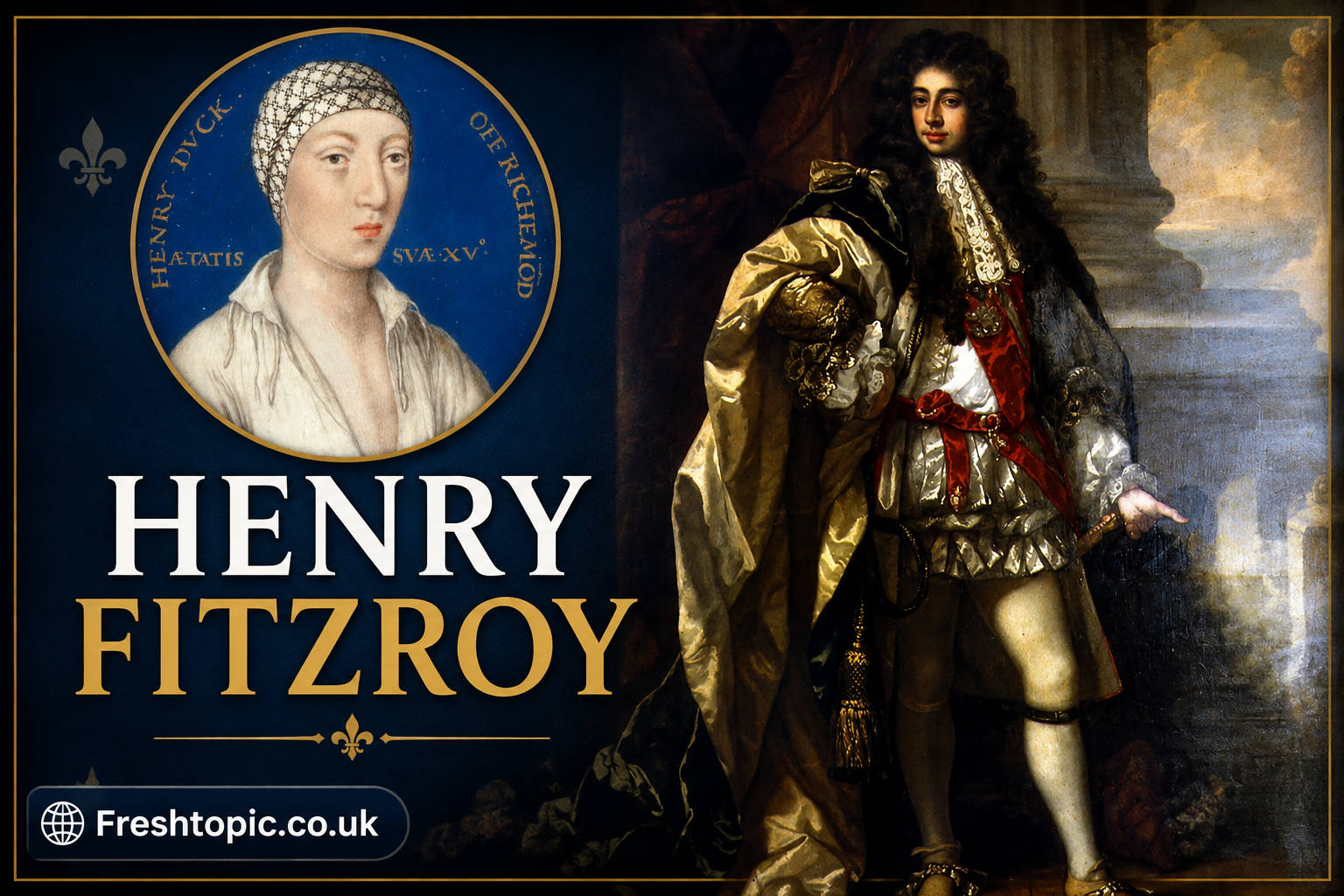
Search “Henry FitzRoy” and you’ll quickly hit a wall of contradictory information — one source says he died a teenager in 1536, another says he died in a military siege in 1690. Both are correct. That’s the frustrating part.
The surname FitzRoy — Norman French for “son of the king” — was given to more than one royal bastard in English history, and the two most searched-for men bearing it lived nearly 150 years apart. Confusing them means confusing entire family trees, historical eras, and even monarchs.
This guide separates the two clearly: Henry FitzRoy, Duke of Richmond and Somerset, the acknowledged son of Henry VIII, and Henry FitzRoy, 1st Duke of Grafton, the son of Charles II. By the end, you’ll know exactly who’s who, how their stories differ, and which one actually has descendants alive today.
Side-by-side portrait comparison of both men. “Henry FitzRoy Duke of Richmond and Somerset next to Henry FitzRoy Duke of Grafton portrait comparison”
Henry FitzRoy, Duke of Richmond and Somerset (1519–1536)
Early Life and Royal Recognition
Henry FitzRoy was born around 15 June 1519, the son of King Henry VIII and his mistress Elizabeth Blount, a lady-in-waiting to Catherine of Aragon. To avoid scandal, Blount was quietly moved away from court to give birth at the Augustinian priory of St Laurence at Blackmore in Essex.
He was, notably, the only illegitimate child Henry VIII ever formally acknowledged as his own. At a time when Henry’s marriage to Catherine of Aragon had produced no surviving son, FitzRoy’s existence carried real political weight. & more blogs to see neural .
Titles, Power, and Possible Succession
In 1525, at just six years old, FitzRoy was made both Duke of Richmond and Duke of Somerset in a single ceremony — a double dukedom that instantly made him the highest-ranking peer in England, outranking every other nobleman at court. He was also appointed Lord High Admiral of England and Lord Lieutenant of Ireland, and installed as a Knight of the Garter, all while still a child.
Henry VIII seriously considered making FitzRoy his heir once it became clear Anne Boleyn had not produced a surviving son. There was even talk — never realized — of seeking a papal dispensation for FitzRoy to marry his own half-sister, Mary, to unite the king’s legitimate and illegitimate lines.
Featured snippet target — “Was Henry FitzRoy considered for the throne?”
Yes. Because Henry VIII had no surviving legitimate son for most of FitzRoy’s life, he was seriously considered as a potential heir and was given titles and offices befitting a future king.
Marriage, Death, and Legacy
In November 1533, FitzRoy married Lady Mary Howard, daughter of the Duke of Norfolk. The marriage was reportedly never consummated, likely due to the couple’s youth or concerns about FitzRoy’s health.
He died on 23 July 1536 at age 17, probably from tuberculosis — just one year before Henry VIII finally had a legitimate son, Edward, with Jane Seymour. He was buried at Thetford Priory before later being moved to St Michael the Archangel’s Church in Framlingham, Suffolk.
Because his marriage was never consummated and he died so young, this Henry FitzRoy left no descendants.
Henry FitzRoy, 1st Duke of Grafton (1663–1690)
Birth and Parentage
Born on 28 September 1663 at the Palace of Whitehall, this Henry FitzRoy was the second illegitimate son of King Charles II and his mistress Barbara Villiers, later Duchess of Cleveland. Unlike the Tudor-era FitzRoy, he grew up in a royal court that was far more open about the king’s illegitimate children — Charles II fathered numerous acknowledged children by several mistresses.
Military Career and Titles
FitzRoy’s path ran through the military rather than politics. He was appointed colonel of the Grenadier Guards in 1681 and served as Vice-Admiral of England from 1682 to 1689. A wealthy marriage in 1672 to Isabella Bennet, daughter and heiress of the Earl of Arlington, brought him the title Earl of Euston; in 1675, Charles II created him Duke of Grafton.
Death in Ireland
FitzRoy was killed in October 1690 during the storming of Cork in the Williamite–Jacobite War, at just 27 years old. A street near where he was shot, Grafton Alley in Cork, still bears a version of his name today.
Henry FitzRoy Descendants
This is where the two men diverge most sharply — and where most search confusion originates.
Did the Duke of Richmond and Somerset Have Descendants?
No. Henry FitzRoy, Duke of Richmond and Somerset, died childless at 17. His marriage to Mary Howard was never consummated, and he had no other recorded children. His branch of the FitzRoy line ended with his death in 1536.
The Duke of Grafton’s Living Descendants
By contrast, Henry FitzRoy, 1st Duke of Grafton, has an unbroken male-line descent that continues today. His only son, Charles FitzRoy, became the 2nd Duke of Grafton, and the title has passed down through eleven further generations.
The current holder is Henry Oliver Charles FitzRoy, 12th Duke of Grafton, born in 1978, a direct male-line descendant of Charles II through his ancestor’s line. He inherited the dukedom from his grandfather in 2011 and today works as a music promoter, with his family seat at Euston Hall in Suffolk.
Notable Descendants Through History
- Augustus FitzRoy, 3rd Duke of Grafton served as Prime Minister of Great Britain from 1768 to 1770.
- Through his son Charles, the 1st Duke of Grafton is an ancestor of Diana, Princess of Wales — meaning Princes William and Harry both descend from this line.
- The Grafton dukedom has held subsidiary titles including Earl of Euston, Viscount Ipswich, and Baron Sudbury since 1675.
Featured snippet target — “Are there living descendants of Henry FitzRoy?”
Yes, but only through the Duke of Grafton line. Henry FitzRoy, 1st Duke of Grafton (1663–1690), has an unbroken line of descendants continuing to the present 12th Duke of Grafton. Henry FitzRoy, Duke of Richmond and Somerset (Henry VIII’s son), died without children in 1536.
Family tree graphic showing the Duke of Grafton lineage from 1675 to present. “Henry FitzRoy descendants family tree Duke of Grafton lineage”
Comparison Table: The Two Henry FitzRoys
| Duke of Richmond and Somerset | 1st Duke of Grafton | |
|---|---|---|
| Lived | 1519–1536 | 1663–1690 |
| Royal father | Henry VIII | Charles II |
| Mother | Elizabeth Blount | Barbara Villiers |
| Titles created | 1525 | 1675 |
| Career | Groomed as potential heir | Military commander, Vice-Admiral |
| Marriage | Mary Howard (unconsummated) | Isabella Bennet |
| Cause of death | Tuberculosis (likely) | Killed in battle at Cork |
| Descendants today | None | Yes — 12th Duke of Grafton |
Pros and Cons of Being an Acknowledged Royal Bastard in Tudor/Stuart England
| Pros | Cons |
|---|---|
| Access to titles, wealth, and high office at a young age | Legitimacy could always be challenged or revoked |
| Possible path to the throne if no legitimate heir existed | Political marriages arranged with little personal say |
| Royal protection and elevated social standing | Often used as a political pawn between noble families |
| Could found lasting noble dynasties (as Grafton did) | Early death was common given medical limitations of the era |
Why This Matters
Getting these two men mixed up isn’t just a trivia error — it changes the entire historical narrative. Henry VIII’s FitzRoy represents a pivotal “what if” moment in Tudor succession history: had he lived and been legitimized, England’s entire royal line — and the break with Rome that followed Henry’s search for a legitimate male heir — might have unfolded differently.
Charles II’s FitzRoy, meanwhile, represents something rarer in English aristocratic history: an illegitimate royal line that survived, thrived, and still holds a hereditary title nearly 350 years later. Understanding the difference matters for genealogists, students of Tudor and Stuart history, and anyone researching the modern Duke of Grafton’s ancestry.
Expert Recommendations for Researching Henry FitzRoy
- Always check the birth and death years first. The fastest way to identify which Henry FitzRoy a source is discussing.
- Cross-reference the royal father. Henry VIII’s son predates Charles II’s son by roughly 130 years.
- Use primary genealogical sources like Burke’s Peerage or the Dictionary of National Biography for verifying descent claims, rather than relying solely on general encyclopedias.
- When researching “Henry FitzRoy descendants,” specify which duke you mean — search engines and AI tools often blend results from both men.
- Visit Euston Hall’s historical records or the College of St George’s archives for primary-source material on either FitzRoy.
Common Mistakes to Avoid When Researching Henry FitzRoy
- Assuming there’s only one Henry FitzRoy. At least two prominent historical figures share the name, plus several later descendants also named Henry.
- Confusing “Duke of Richmond and Somerset” with the later Dukes of Richmond. The Richmond and Somerset title became extinct in 1536; a separate Dukedom of Richmond was later created for a different illegitimate son of Charles II, Charles Lennox.
- Assuming all Stuart-era FitzRoys have surviving descendants. Several of Charles II’s illegitimate children’s lines did die out; the Grafton line is a notable survivor.
- Overlooking the Diana, Princess of Wales connection, which is a frequently searched but often mishandled fact about the Grafton lineage.
- Citing genealogy forums as primary sources. Cross-check descent claims against peerage records.
Conclusion
Henry FitzRoy’s name has been attached to two very different chapters of English royal history — one a Tudor prince who never got the chance to grow up, the other a Stuart duke whose bloodline still holds a hereditary title today. Understanding which Henry FitzRoy a source is talking about is the key to getting the history — and the genealogy — right.
Whether you came here chasing Tudor succession drama or tracing a modern family tree back to Charles II, you now have the full picture, backed by verified historical and genealogical sources.
FAQs
Who was Henry FitzRoy?
Henry FitzRoy most commonly refers to either Henry FitzRoy, Duke of Richmond and Somerset (1519–1536), the acknowledged illegitimate son of Henry VIII, or Henry FitzRoy, 1st Duke of Grafton (1663–1690), the illegitimate son of Charles II.
Was Henry FitzRoy Henry VIII’s only illegitimate child?
He was the only illegitimate child Henry VIII ever officially acknowledged as his own, though the king may have fathered other children who were never formally recognized.
Did Henry FitzRoy, Duke of Richmond and Somerset, have children?
No. He married Mary Howard in 1533, but the marriage was reportedly never consummated, and he died in 1536 at age 17 without any children.
Who are Henry FitzRoy’s descendants today?
Through Henry FitzRoy, 1st Duke of Grafton, descendants continue to the present day. The current title holder is Henry Oliver Charles FitzRoy, 12th Duke of Grafton, born in 1978.
Was Henry FitzRoy in line for the English throne?
Henry FitzRoy, Duke of Richmond and Somerset, was seriously considered by Henry VIII as a possible heir before the birth of Edward VI, though he was never formally legitimized or named successor.
How did Henry FitzRoy, 1st Duke of Grafton, die?
He was killed in October 1690 during the storming of Cork in the Williamite–Jacobite War, at the age of 27.
Is Diana, Princess of Wales related to Henry FitzRoy?
Yes. Through his son Charles, 2nd Duke of Grafton, Henry FitzRoy, 1st Duke of Grafton, is an ancestor of Diana, Princess of Wales.
What does the surname FitzRoy mean?
FitzRoy is Norman French for “son of the king,” a surname historically given to acknowledged illegitimate children of English monarchs.
In Short
- “Henry FitzRoy” most often refers to two distinct historical figures roughly 130 years apart.
- Henry VIII’s son, Duke of Richmond and Somerset, died childless at 17 in 1536.
- Charles II’s son, 1st Duke of Grafton, founded a dynasty that survives to this day.
- The current Duke of Grafton, Henry Oliver Charles FitzRoy, was born in 1978.
- The Grafton line connects to Diana, Princess of Wales, and by extension to Princes William and Harry.
- Always verify birth/death dates and the royal father when researching either man.