









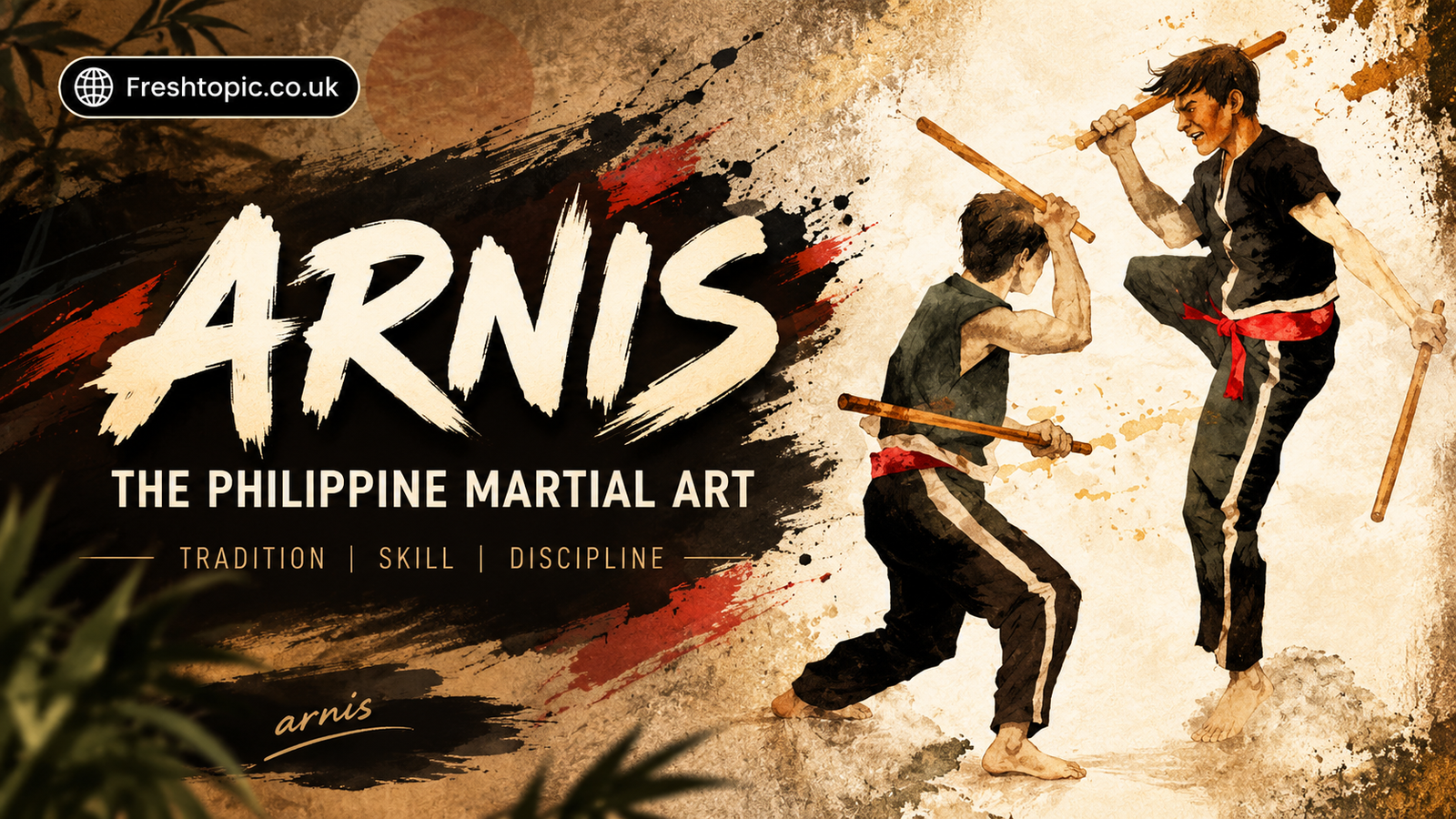
Ever watched a Bourne movie fight scene and wondered what that blur of sticks and elbows actually was? Chances are, you were watching Arnis — or a Hollywood fight choreographer’s version of it.
Here’s the problem: most people searching for “arnis” land on either dense academic history pages or thin fitness-blog fluff that never actually explains what the art is, how it’s trained, or whether it’s worth your time. That’s frustrating if you’re genuinely trying to decide whether to walk into a class.
This guide fixes that. By the end, you’ll understand exactly what Arnis martial arts involves, how it compares to Eskrima and Kali, what a real class looks like, and how to find training near you — including a quick note on the unrelated “Arnis” tool some Minecraft players search for by the same name.
What Is Arnis?
Arnis is the national martial art of the Philippines. It’s also known as eskrima or kali, and these three terms are sometimes used interchangeably to refer to traditional Filipino martial arts, collectively called Filipino Martial Arts (FMA).
Arnis emphasizes weapon-based fighting using sticks, knives, bladed weapons, and various improvised objects, alongside empty-hand techniques. Unlike many martial arts that start students with empty-hand basics before introducing weapons, Arnis typically teaches weapon work from day one — the logic being that weapon skills transfer naturally to empty-hand movement, not the other way around.& more blogs neural .
Arnis, Eskrima, and Kali — Are They the Same?
Mostly, yes — with regional flavor differences:
- Arnis — the term most commonly used in Luzon (northern Philippines) and the name recognized in official Filipino government designations.
- Eskrima/Escrima — more common in the Visayas region.
- Kali — a term more widely used by Filipino martial artists in the United States, especially in California and Hawaii.
All three describe the same broader family of stick, blade, and empty-hand combat systems, though specific schools and lineages (like Doce Pares or Modern Arnis) may emphasize different techniques within that family.
[image placement: two practitioners sparring with rattan sticks. “arnis martial arts practitioners training with sticks”]
The History of Arnis
Arnis developed out of the Philippines’ need to defend itself against centuries of foreign invaders, with practitioners becoming known for swift, elusive stick work that struck fear into opponents. The word “arnis” itself traces back to the Spanish word “arnés,” reflecting the centuries of Spanish colonial influence on Filipino culture and language.
Recognition of the art has grown well beyond the Philippines. There have been ongoing efforts to have arnis and other Philippine martial arts nominated for UNESCO’s Intangible Cultural Heritage Lists, and as of 2018, UNESCO has inscribed nine martial-arts-related intangible heritages worldwide.
Core Arnis Techniques
Arnis training generally progresses through three interconnected skill areas.
Single Stick (Solo Baston)
The foundation of most Arnis curricula. Students learn strike patterns (often numbered 1 through 12), footwork, and blocking angles using a single rattan stick, typically 26–28 inches long.
Double Stick (Doble Baston)
Once single-stick coordination is solid, many schools introduce a second stick. This dramatically increases the complexity of offense and defense, training both hands to move independently — a skill that also sharpens coordination and reaction time.
Empty-Hand Techniques (Mano-Mano)
Empty-hand training techniques are translated from the use of the dagger or stick, so the same angles and motions used with a weapon carry directly into striking, joint locks, and disarms without one. This is a defining feature of Arnis: the weapon isn’t separate from the empty-hand system — it’s the blueprint for it.
Benefits of Training in Arnis
Beyond self-defense, Arnis offers measurable physical and cognitive benefits:
- Hand-eye coordination — tracking and intercepting a moving stick trains reflexes that carry into everyday life and other sports.
- Cardiovascular conditioning — sustained stick drills are a genuine workout.
- Bilateral coordination — double-stick work forces both hemispheres of the brain to engage simultaneously, a benefit occupational therapists sometimes reference for motor-skill development.
- Practical self-defense — training against weapons (even training weapons) builds situational awareness that’s directly transferable to real-world altercations, armed or not.
Pros and Cons
| Pros | Cons |
|---|---|
| Weapon skills transfer to empty-hand defense | Fewer schools available compared to karate/BJJ/Taekwondo in most U.S. cities |
| Strong cardio and coordination benefits | Steeper learning curve for absolute beginners |
| Effective, practical self-defense focus | Sparring with sticks (even padded) carries more injury risk than grappling arts |
| Rich cultural and historical depth | Belt/rank systems vary significantly by lineage, making cross-school comparison harder |
Arnis vs. Other Martial Arts: Comparison Table
| Martial Art | Primary Focus | Weapons Involved | Best For |
|---|---|---|---|
| Arnis | Stick, blade, empty-hand | Sticks, knives, improvised weapons | Weapon-based self-defense, coordination |
| Krav Maga | Practical self-defense | Minimal/situational | Real-world threat response |
| Brazilian Jiu-Jitsu | Ground grappling | None | Ground control, competition |
| Karate | Striking | None (traditionally) | Striking discipline, forms |
| Kali (close relative) | Stick, blade, empty-hand | Sticks, knives | Same family as Arnis, U.S.-common terminology |
How to Get Started in Arnis
Step-by-Step: Your First Class
- Find a certified instructor. Look for lineage — instructors who trace their training back to recognized Filipino grandmasters (such as the Presas or Cañete families) generally teach more authentic, structured curricula.
- Bring or borrow a training stick. Most schools loan rattan sticks for trial classes; you won’t need your own gear on day one.
- Expect drills before sparring. The first few classes focus on strike numbering, footwork, and blocking — not full-contact sparring.
- Wear comfortable, athletic clothing. No gi or uniform is typically required to start.
- Ask about safety gear. Padded sticks and basic protective gear are standard once sparring begins.
Where to Train Arnis Near Brownsburg, Indiana
If you’re searching for Arnis classes specifically in the Brownsburg, Indiana area, availability can shift as local schools open, close, or change instructors, so the most reliable approach is:
- Search Google Maps for “Arnis,” “Eskrima,” or “Filipino Martial Arts” within a 15–20 mile radius of Brownsburg, since nearby Indianapolis-area schools are more likely to offer FMA than smaller towns.
- Check the World Modern Arnis Alliance school directory, which lists certified instructors and affiliated schools by state.
- Call ahead — many Arnis programs run as add-on classes within larger martial arts academies rather than standalone Arnis-only schools, so it’s worth asking directly whether a nearby dojo offers it even if it’s not advertised as a headline program.
“Arnis” in Minecraft — A Different Kind of Arnis
If you searched “arnis minecraft,” you’re likely not looking for the martial art at all. Arnis is also the name of a free, open-source tool that generates real-world locations inside Minecraft with a high level of detail, built by developer Louis Erbkamm.
The tool transforms real-world geographical data into playable Minecraft Java and Bedrock Edition worlds, recreating streets, buildings, landmarks, and terrain from any location on Earth. It has grown significantly in popularity, serving nearly 300,000 users by processing geospatial data hosted on Amazon Web Services.
It shares a name with the martial art purely by coincidence — there’s no connection between the two, and each has its own dedicated online community.
Why This Matters
Understanding what Arnis actually is — rather than relying on vague pop-culture impressions — matters for a few concrete reasons:
- Informed decision-making. If you’re choosing a martial art for self-defense or fitness, knowing exactly what Arnis trains (weapon-based reflexes, coordination, practical defense) helps you compare it honestly against alternatives like Krav Maga or BJJ.
- Cultural respect. Arnis is the Philippines’ national martial art with deep historical roots; treating it as a novelty (“stick fighting”) rather than a structured discipline undersells its depth.
- Search accuracy. With “Arnis” referring to both a martial art and unrelated software, getting clear, disambiguated information saves time and prevents confusion — especially for parents researching classes for their kids.
Common Mistakes Beginners Make
- Skipping stick fundamentals to “get to sparring.” Strike numbering and footwork aren’t filler — they’re the base every advanced technique builds on.
- Assuming Arnis, Eskrima, and Kali are entirely different arts. They’re regional names for the same broader Filipino Martial Arts family; don’t let terminology confuse your school search.
- Training without eye and hand protection once sparring starts. Even padded sticks can cause injury at speed — never skip safety gear.
- Choosing a school based on price alone. Instructor lineage and teaching structure matter more than proximity or cost for building real skill.
Expert Recommendations
- Prioritize instructor lineage over convenience. A 30-minute drive to a certified instructor is worth more than a nearby class with unclear training credentials.
- Train both hands early. Even before double-stick work, practicing single-stick drills with your non-dominant hand builds the ambidextrous coordination Arnis is known for.
- Cross-reference belt/rank systems. Since ranking varies by lineage, ask instructors directly how their system compares to others before assuming your rank will transfer between schools.
- Watch instructional lineage videos. Footage of grandmasters like Remy Presas or the Cañete family offers a benchmark for authentic technique that’s hard to get from a single local class alone.
Conclusion
Arnis is far more than “stick fighting” — it’s a structured, centuries-old Filipino martial art built on weapon skills that translate directly into empty-hand self-defense, sharp coordination, and real cultural depth. Whether you’re drawn to it for fitness, self-defense, or a connection to Filipino heritage, understanding the difference between Arnis, Eskrima, and Kali — and knowing what to expect in your first class — puts you ahead of most beginners walking through the door.
If you’re ready to start, look up certified Arnis or FMA instructors in your area, ask about their lineage, and sit in on a class before committing.
FAQs
What does Arnis mean?
Arnis is the national martial art of the Philippines, also known as Eskrima or Kali, focused on stick, blade, and empty-hand combat techniques.
Is Arnis good for self-defense?
Yes. Arnis trains practical weapon and empty-hand defense simultaneously, and its focus on angles and disarms translates well to real-world self-defense scenarios, armed or unarmed.
What is the difference between Arnis and Kali?
They largely describe the same family of Filipino Martial Arts; “Arnis” is more common terminology in the Philippines itself, while “Kali” is more frequently used among Filipino martial artists in the United States.
Do I need my own equipment to start Arnis?
No. Most schools provide training sticks for beginners, and protective gear is typically introduced only once sparring begins.
Is “Arnis” the Minecraft tool related to the martial art?
No. They share a name coincidentally — the Minecraft tool is unrelated open-source software for generating real-world maps inside Minecraft, while Arnis the martial art is a centuries-old Filipino combat system.
How long does it take to get good at Arnis?
Like most martial arts, meaningful proficiency typically takes 1–2 years of consistent training, though basic strike patterns and defensive coordination can be learned within the first few months.
In Short
- Arnis is the national martial art of the Philippines, closely related to Eskrima and Kali.
- Training progresses from single-stick to double-stick to empty-hand techniques, all built on the same core angles.
- Benefits include coordination, cardio conditioning, and practical self-defense skills.
- “Arnis” in Minecraft refers to an entirely unrelated open-source world-generation tool.
- When searching for local classes (including near Brownsburg, Indiana), broaden your search radius and check FMA-specific directories, since Arnis is often taught as an add-on program rather than a standalone school.