









You’ve probably heard of the seven deadly sins — pride, greed, envy, and the rest. They show up in movies, memes, and pop culture constantly.
But their counterpart, the 7 heavenly virtues, rarely gets the same spotlight. And that’s a shame, because these virtues were designed as a practical roadmap — a way to counter humanity’s worst impulses with intentional, positive character traits.
If you’ve ever felt stuck in a cycle of bad habits, comparison, or self-criticism, understanding the 7 heavenly virtues can give you something the sins never could: a constructive path forward.
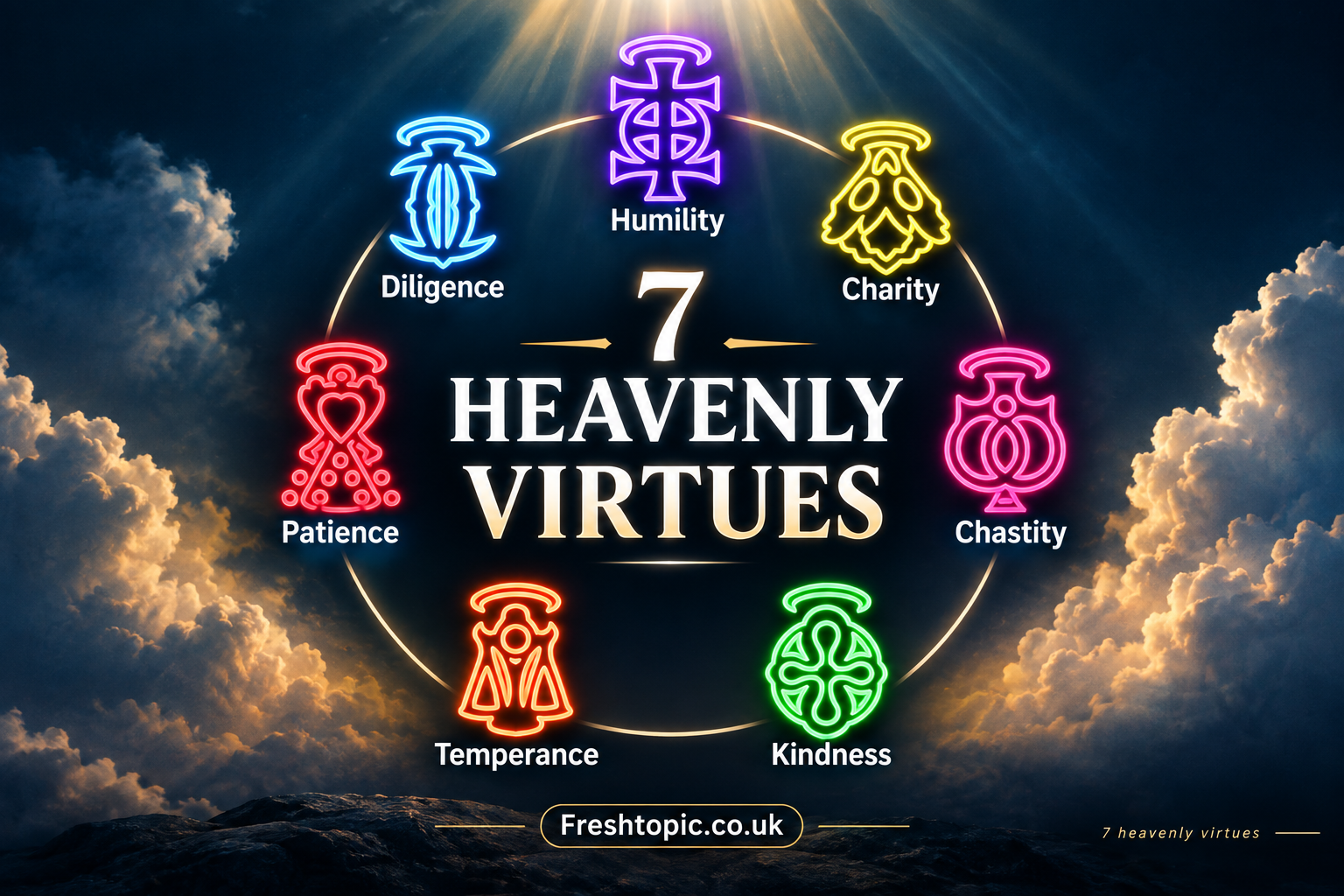
The 7 heavenly virtues are: chastity, temperance, charity, diligence, patience, kindness, and humility. Together, they form a moral framework rooted in Christian theology and classical philosophy, each one intended to directly counterbalance one of the seven deadly sins.
This guide breaks down where these virtues come from, what each one means, their symbols, and how they compare to the sins they were built to oppose — plus practical ways to apply them today.
(Suggested image: an infographic titled “The 7 Heavenly Virtues” —”7 heavenly virtues list with symbols and meanings”)
Where Do the 7 Heavenly Virtues Come From?
The 7 heavenly virtues aren’t a single ancient list — they’re a blend of two older traditions that merged over centuries of philosophical and theological development. & more blogs digital .
The Four Cardinal Virtues (Ancient Greek Roots)
Four of the seven — temperance, justice, courage, and prudence — trace back to classical Greek philosophy, especially Plato and Aristotle. These were considered “cardinal” because all other virtues were thought to hinge (cardo, in Latin, means “hinge”) on them.
The Three Theological Virtues (Christian Addition)
Early Christian theology, particularly through the writings of St. Paul and later systematized by Thomas Aquinas, added three theological virtues: faith, hope, and charity (love). These were considered gifts from God rather than traits developed purely through reason.
The commonly cited “7 heavenly virtues” list that most people reference today — chastity, temperance, charity, diligence, patience, kindness, and humility — actually emerged later, popularized as the direct opposites of the seven deadly sins (a list formalized around the 6th century by Pope Gregory I and refined by Dante Alighieri in The Divine Comedy).
The 7 heavenly virtues are chastity, temperance, charity, diligence, patience, kindness, and humility. They were developed as the direct opposites of the seven deadly sins.
The 7 Heavenly Virtues List, Explained One by One
1. Chastity
Chastity counters lust. It represents purity of intention, self-respect, and restraint — not necessarily abstinence, but the discipline to align actions with one’s values rather than impulse.
2. Temperance
Temperance counters gluttony. It’s the practice of moderation in all things: food, drink, spending, screen time, ambition. Temperance isn’t about deprivation — it’s about balance.
3. Charity
Charity counters greed. Rooted in the Latin caritas, it means selfless love and generosity — giving time, resources, or compassion without expecting anything back.
4. Diligence
Diligence counters sloth. It’s sustained effort, work ethic, and follow-through — showing up consistently, even when motivation fades.
5. Patience
Patience counters wrath. It’s the ability to stay calm under pressure, respond instead of react, and tolerate delay or difficulty without losing composure.
6. Kindness
Kindness counters envy. Instead of resenting others’ success, kindness redirects that energy into empathy, encouragement, and goodwill.
7. Humility
Humility counters pride. It’s an honest, grounded self-assessment — recognizing your worth without inflating it, and staying open to feedback and growth.
a table graphic pairing each virtue with its opposing sin — “7 heavenly virtues vs 7 deadly sins comparison chart”)
7 Heavenly Virtues Symbols
Each virtue is often represented visually in Christian art, stained glass, and literature. While symbolism varies by source, these are the most widely recognized associations:
| Virtue | Common Symbol | Symbolic Meaning |
|---|---|---|
| Chastity | Lily or white dove | Purity, innocence |
| Temperance | Water and wine jug, bridle | Moderation, self-control |
| Charity | Heart, or a figure giving bread | Selfless love, generosity |
| Diligence | Bee or ant | Steady, productive effort |
| Patience | Lamb, or an anchor | Endurance, calm steadiness |
| Kindness | Open hand, dove | Compassion, goodwill |
| Humility | Bowed head, or a violet flower | Modesty, groundedness |
These symbols appear frequently in Renaissance art, cathedral carvings, and medieval manuscripts — most famously in works inspired by Dante’s Purgatorio and Giotto’s frescoes in the Scrovegni Chapel.
7 Heavenly Virtues vs. 7 Deadly Sins: Side-by-Side Comparison
| Heavenly Virtue | Opposing Deadly Sin | Core Idea |
|---|---|---|
| Chastity | Lust | Purity over impulsive desire |
| Temperance | Gluttony | Moderation over excess |
| Charity | Greed | Generosity over hoarding |
| Diligence | Sloth | Effort over laziness |
| Patience | Wrath | Calm over anger |
| Kindness | Envy | Goodwill over resentment |
| Humility | Pride | Groundedness over ego |
This pairing isn’t coincidental — medieval theologians deliberately structured the virtues as direct antidotes to the sins, giving people a practical “if-then” framework: if you’re prone to envy, actively cultivate kindness; if you struggle with sloth, build diligence.
Why This Matters
You don’t need to be religious to find value in this framework. Here’s why it still matters in a secular, modern context:
- It’s a built-in self-improvement system. Instead of vague goals like “be a better person,” the virtues give you seven specific, actionable traits to work on.
- It counters modern pressures directly. Social media fuels envy and pride; consumer culture fuels greed and gluttony. The virtues offer a deliberate counterbalance.
- It’s culturally embedded. These concepts appear in literature, art, psychology, and even corporate leadership training — understanding them helps you recognize references across fields.
- Research supports virtue-based practice. Studies in positive psychology (notably from Martin Seligman’s character strengths research) show that intentionally practicing traits like gratitude, self-control, and humility correlates with higher life satisfaction and lower anxiety.
Common Mistakes to Avoid When Interpreting the Virtues
- Confusing chastity with celibacy. Chastity is about intentionality and self-respect, not necessarily abstinence.
- Treating temperance as total restriction. Moderation, not deprivation, is the goal.
- Assuming the list is fixed everywhere. Some sources cite the four cardinal + three theological virtues (justice, courage, prudence, temperance, faith, hope, charity) as “the 7 heavenly virtues” — a different but related list. Always clarify which version a source is using.
- Overlooking cultural context. These virtues emerged from a specific historical and religious framework; applying them rigidly without context can feel forced.
- Turning humility into self-deprecation. True humility is accurate self-assessment, not putting yourself down.
Pros and Cons of Using the 7 Virtues as a Personal Framework
Pros:
- Clear, memorable structure for self-reflection
- Directly maps to common modern struggles (comparison, burnout, anger)
- Backed by centuries of philosophical and psychological relevance
- Works across religious and secular contexts
Cons:
- Rooted in religious language that may feel exclusionary to some
- Definitions have shifted over centuries, causing confusion
- Can feel moralistic or rigid if applied without nuance
- Not empirically “measurable” the way modern psychology frameworks are
Expert Recommendations: How to Practice the Virtues Daily
- Pick one virtue per month. Trying to master all seven at once leads to burnout. Focus deeply on one at a time.
- Pair it with its opposing sin. If you’re working on patience, track moments when wrath (irritation, snapping) shows up — awareness is the first step.
- Use journaling prompts. End each day by noting one moment you practiced a virtue and one moment you slipped.
- Apply it to specific domains. Practice temperance with screen time, diligence with a work project, kindness with a difficult coworker.
- Revisit art and literature. Reading Dante’s Purgatorio or studying Renaissance depictions of the virtues adds depth and context that pure definitions can’t provide.
Conclusion
The 7 heavenly virtues aren’t just a relic of medieval theology — they’re a surprisingly practical framework for navigating modern struggles like comparison, burnout, and impulsivity. By understanding what each virtue means, where it came from, and how it directly counters a specific vice, you gain a clearer, more intentional path toward personal growth.
Whether you approach this through a spiritual lens or a purely psychological one, the core idea holds up: naming the trait you want to build is the first step toward actually building it.
FAQs
What are the 7 heavenly virtues in order?
Chastity, temperance, charity, diligence, patience, kindness, and humility — though order varies by source, as they aren’t ranked hierarchically.
What are the 7 heavenly virtues vs. 7 deadly sins?
The heavenly virtues (chastity, temperance, charity, diligence, patience, kindness, humility) were formed as direct opposites of the seven deadly sins (lust, gluttony, greed, sloth, wrath, envy, pride).
Are the 7 heavenly virtues in the Bible?
Not as a single unified list. Faith, hope, and charity appear explicitly in Scripture (1 Corinthians 13), while the cardinal virtues come from Greek philosophy. The commonly cited “7 heavenly virtues vs. sins” list developed later through theologians and writers like Dante.
What is the symbol for each of the 7 heavenly virtues?
Common symbols include a lily (chastity), a water jug (temperance), a heart (charity), a bee (diligence), a lamb (patience), an open hand (kindness), and a bowed head or violet (humility).
Do I need to be religious to practice the 7 heavenly virtues?
No. Many people apply these traits as a secular self-improvement framework, since concepts like patience, kindness, and diligence are universally valuable.
What is the difference between the cardinal virtues and the heavenly virtues?
Cardinal virtues (prudence, justice, courage, temperance) come from Greek philosophy and focus on reasoned character. The commonly listed “heavenly virtues” (chastity, temperance, charity, diligence, patience, kindness, humility) are specifically structured as opposites to the deadly sins.
In Short
- The 7 heavenly virtues are chastity, temperance, charity, diligence, patience, kindness, and humility.
- They were developed as direct counterparts to the 7 deadly sins.
- The framework blends Greek cardinal virtues and Christian theological virtues.
- Each virtue has traditional symbols rooted in religious art and literature.
- You don’t need to be religious to apply these traits for personal growth.