











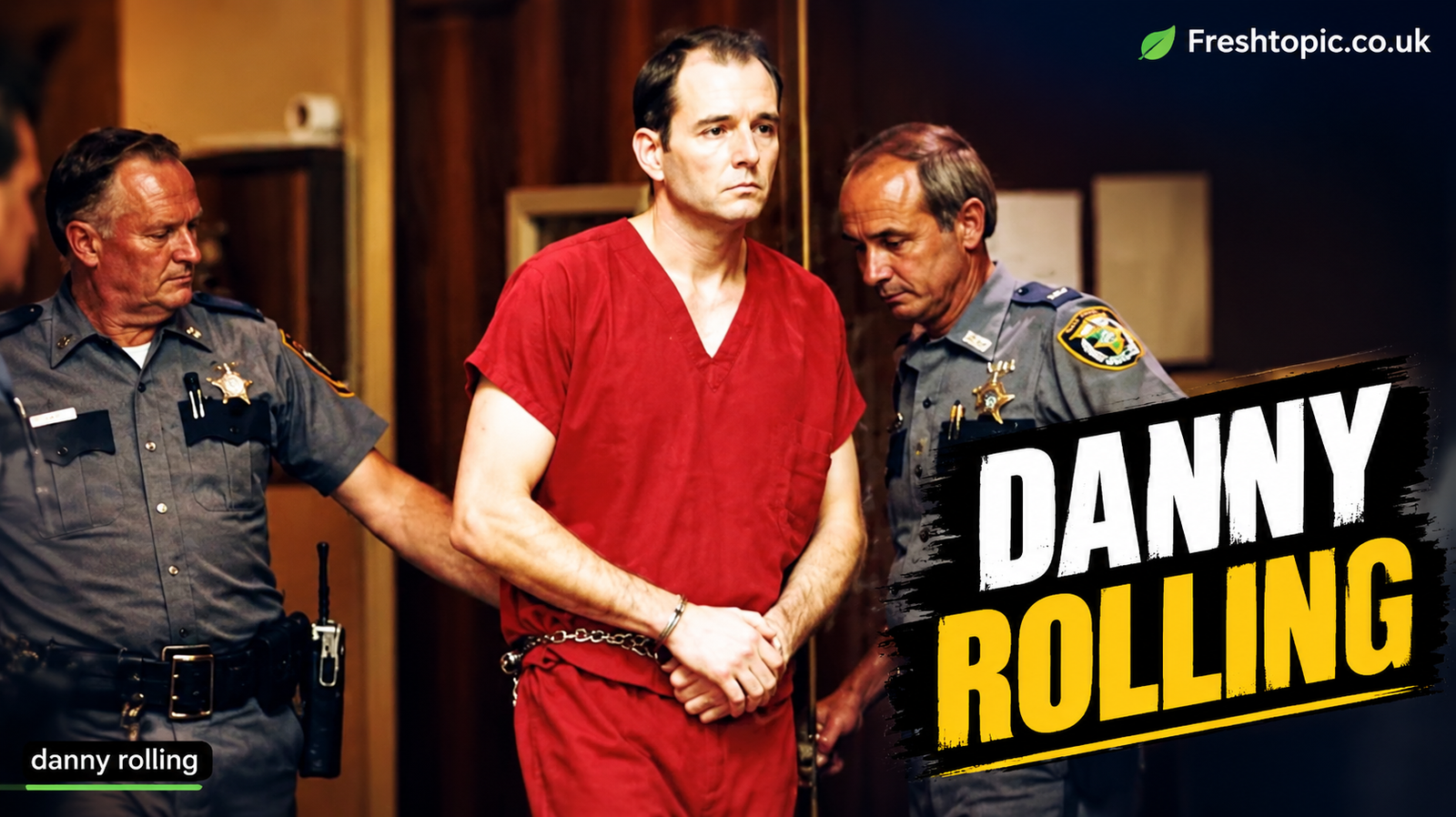
Few true crime cases shook a college town the way the Danny Rolling murders shook Gainesville, Florida, in August 1990. In just four days, a first-week-of-classes celebration turned into a citywide panic, as five students were found brutally killed in their own apartments. If you’ve searched for the Danny Rolling crime scene, the Danny Rolling victims, or a reliable Danny Rolling documentary, you’ve probably run into scattered, inconsistent, or overly sensationalized information.
This guide pulls the verified facts together in one place: what happened, who the victims were, how investigators built their case, and where you can watch accurate documentary coverage — without resorting to shock-value details that do a disservice to the victims’ memory.
black-and-white photo of the University of Florida campus, 1990 — “University of Florida campus during the 1990 Danny Rolling murders”)
Who Was Danny Rolling?
Daniel Harold Rolling was born May 26, 1954, in Shreveport, Louisiana. Before he became known as the “Gainesville Ripper,” Rolling had a long record of burglary and armed robbery, along with a documented history of childhood abuse that experts later cited as a contributing factor in his violent behavior.
By the time he arrived in Florida in mid-1990, Rolling had already committed a triple homicide in Shreveport — a crime that wasn’t connected to him until after his Florida arrest. He also shot his own father in the face during a violent confrontation months before the Gainesville murders began. & more blogs neural .
The Danny Rolling Murders Timeline (August 1990)
The Danny Rolling murders unfolded over just four days, right as University of Florida students were returning for the fall semester.
Christina Powell and Sonja Larson
On August 24, 1990, Rolling broke into an apartment shared by 17-year-old Christina Powell and 18-year-old Sonja Larson. Both women were killed with a hunting knife.
Christa Hoyt
The following day, Rolling broke into the home of 18-year-old Christa Hoyt and waited for her to return. She became his third victim.
Tracy Paules and Manuel Taboada
On August 27, Rolling entered an apartment shared by 23-year-olds Tracy Paules and Manuel “Manny” Taboada, a former high school football player. Both were killed, bringing the total to five victims in four days.
The Danny Rolling Crime Scene: What Investigators Found
Crime scene investigators noted several unusual, consistent details across the different Gainesville locations. Without going into graphic specifics, key elements included:
- Forced entry through sliding doors or windows
- Evidence the killer stayed in the apartments after the murders
- Deliberate staging of the scenes, which became a critical forensic signature
Signature Behaviors That Linked the Cases
These staging patterns were what eventually connected the Gainesville killings to the unsolved 1989 Shreveport triple homicide. Investigators recognized the same “signature” behavior in both cases — a detail that ultimately helped confirm Rolling’s guilt beyond just DNA evidence.
forensic evidence diagram — “Danny Rolling crime scene evidence timeline map”)
Danny Rolling Victims: Full List and Background
| Victim | Age | Date | Location |
|---|---|---|---|
| Christina Powell | 17 | Aug 24, 1990 | Gainesville apartment |
| Sonja Larson | 18 | Aug 24, 1990 | Gainesville apartment |
| Christa Hoyt | 18 | Aug 25, 1990 | Gainesville apartment |
| Tracy Paules | 23 | Aug 27, 1990 | Gainesville apartment |
| Manuel Taboada | 23 | Aug 27, 1990 | Gainesville apartment |
Rolling later confessed to three additional murders in Shreveport in 1989, br1nging his confirmed total to eight victims.
How Danny Rolling Was Caught
Rolling was arrested on September 7, 1990 — not initially for the murders, but on unrelated robbery charges. DNA evidence (still a relatively new forensic tool at the time) eventually linked him conclusively to the Gainesville crime scenes.
Trial, Confession, and Execution
Rolling pleaded guilty in 1994 and was sentenced to death on all five counts of first-degree murder. He spent over a decade on death row, during which he became a controversial figure in the “murderabilia” art market. He was executed by lethal injection on October 25, 2006.
Danny Rolling Documentary Recommendations
If you’re looking for a Danny Rolling documentary, quality and accuracy vary widely across streaming platforms. Here’s a quick breakdown of what to expect from each format.
Pros and Cons of Each Documentary Type
| Format | Pros | Cons |
|---|---|---|
| Network true crime specials | Concise, widely available | Often lack case depth |
| Independent podcasts/YouTube | Deep dives, victim-focused | Varying accuracy |
| Court/news archival footage | Highest factual accuracy | Less narrative polish |
Expert tip: Prioritize documentaries that cite court records, law enforcement interviews, or contemporaneous news coverage over dramatized reenactments.
Why This Matters
The Danny Rolling case changed campus safety policy nationwide. Gainesville’s response — increased apartment security requirements, student safety escorts, and expanded university police patrols — became a model referenced by other college towns. Understanding this case isn’t just about true crime curiosity; it’s about the tangible safety reforms that followed.
Expert Recommendations
- Cross-reference documentary claims against court records or established outlets like the Associated Press or major Florida newspapers.
- Approach “murderabilia” content critically — much of it romanticizes offenders in ways that ignore victims.
- If researching for academic or journalistic purposes, prioritize primary sources: trial transcripts, contemporaneous news archives, and law enforcement statements.
Mistakes to Avoid When Researching True Crime Cases Like This
- Relying on a single sensationalized blog or forum post as fact
- Confusing dramatized documentary reenactments with verified evidence
- Overlooking victims’ names and stories in favor of offender-centric narratives
Conclusion
The Danny Rolling murders remain one of the most sobering chapters in American true crime history — not because of shock value, but because of what they reveal about crime scene forensics, campus safety, and the long shadow a single week of violence can cast over a community. From the August 1990 attacks in Gainesville to Rolling’s 2006 execution, the case shows how DNA evidence and behavioral “signature” analysis can close cases that once seemed unsolvable.
If this breakdown helped you understand the Danny Rolling case more clearly, consider sharing it with fellow true crime readers, or explore our related coverage on campus safety reforms and how forensic DNA evidence has changed cold-case investigations.
FAQs
What was Danny Rolling’s motive?
Investigators and psychologists pointed to a combination of childhood abuse, a documented history of violent crime, and a stated desire for infamy.
How many victims did Danny Rolling have?
He was convicted of five murders in Gainesville, Florida, and confessed to three additional Shreveport killings, for a total of eight confirmed victims.
When was Danny Rolling executed?
He was executed by lethal injection on October 25, 2006, at Florida State Prison.
Is there a good Danny Rolling documentary to watch?
Look for documentaries that rely on court records and contemporaneous news footage rather than heavily dramatized reenactments for the most accurate account.
How was Danny Rolling caught?
He was arrested in September 1990 on unrelated robbery charges; DNA evidence later linked him to the Gainesville murders.
In short
- The Danny Rolling murders occurred over four days in August 1990 in Gainesville, Florida.
- Five University of Florida students were killed; Rolling later confessed to three more murders in Louisiana.
- Crime scene staging patterns helped investigators connect the Florida and Louisiana cases.
- Rolling was executed in 2006 after pleading guilty in 1994.
- Documentary accuracy varies significantly — prioritize sources grounded in court records.