









You’re staring at a piece of sheet music, and right at the top, above the very first measure, sits one word: Allegro. No number. No click track. Just a single Italian word standing between you and knowing how fast to actually play.
This is one of the most common frustrations for musicians at every level — tempo markings feel more like vibes than instructions. Play it too slow, and the piece drags. Play it too fast, and you lose control of the notes entirely.
This guide fixes that confusion for good. You’ll learn exactly what allegro tempo means, its precise BPM range, how to set your metronome correctly, and how to avoid the most common mistakes musicians make when interpreting it — so you never have to guess at a tempo marking again.
What Does Allegro Tempo Mean?
Allegro is an Italian musical term meaning “cheerful” or “lively,” used to indicate a fast, upbeat tempo. It’s one of the most frequently used tempo markings in Western classical music, appearing in everything from Baroque concertos to modern film scores.
Beyond speed alone, allegro traditionally implies a bright, energetic character — not just quick notes, but a sense of lightness and forward motion. This is why a piece marked allegro should feel purposeful and driven, rather than simply rushed.
Tempo markings like allegro date back centuries, originally used because composers didn’t have metronomes or BPM numbers to rely on. Instead, they used descriptive Italian words to communicate both speed and mood at once — a tradition that has stuck around even in today’s more precise, metronome-driven music education. & more blogs neural .
Allegro Tempo BPM: The Exact Range Explained
Allegro tempo generally falls between 120 and 156 beats per minute (BPM). Some sources extend the upper range slightly to 168 BPM, depending on the specific style or era of music being performed.
This range places allegro solidly in “fast” territory — noticeably quicker than a moderate walking pace (moderato, around 108–120 BPM) but not as extreme as the fastest tempo markings like presto.
Allegro vs. Related Tempo Markings
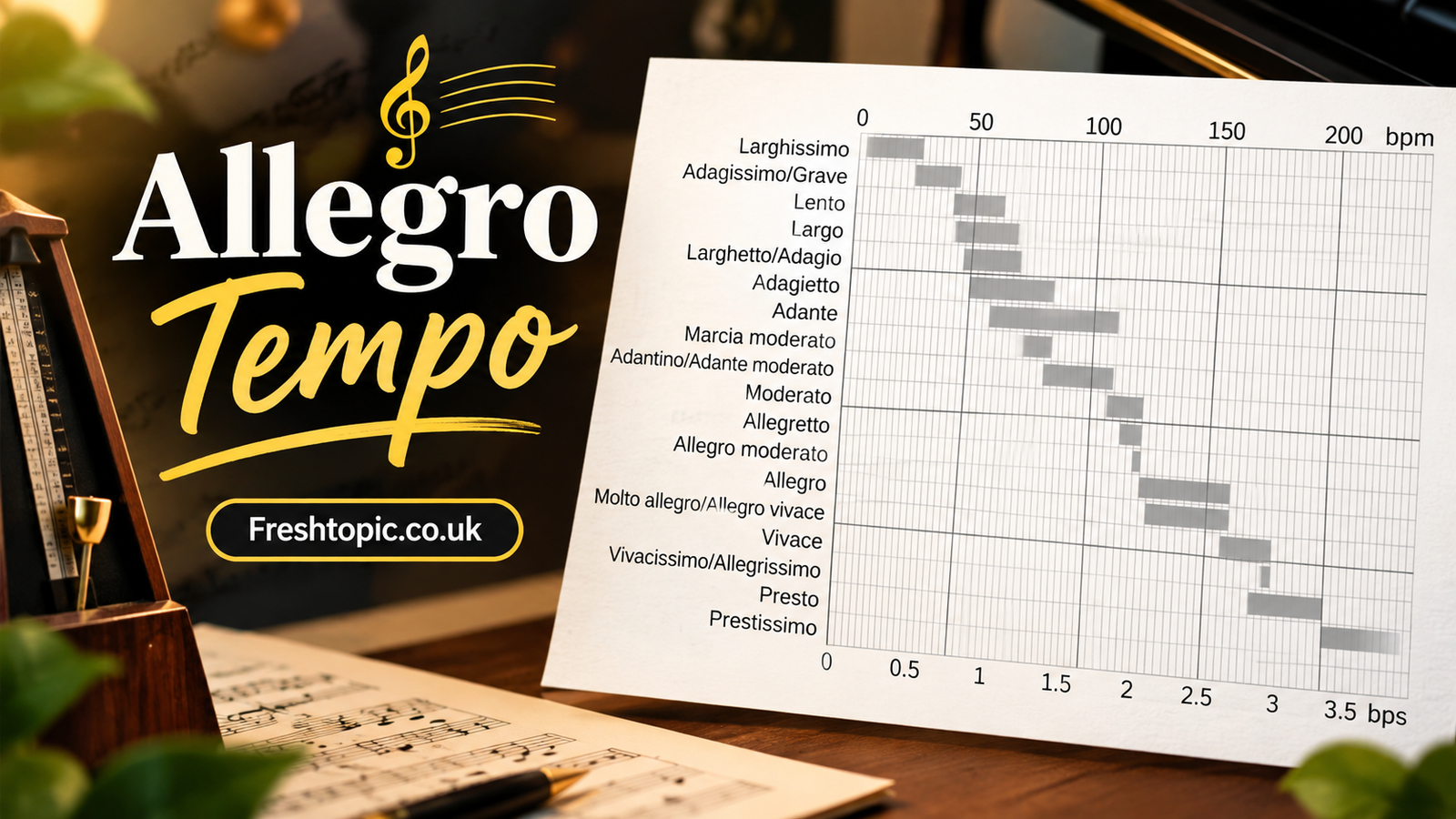
Allegro doesn’t exist in isolation — it’s part of a full spectrum of Italian tempo terms, each covering a specific BPM range. Understanding where allegro sits relative to its neighbors makes tempo markings far easier to interpret at a glance.
Comparison Table: Allegro and Nearby Tempo Markings
| Tempo Marking | Meaning | BPM Range |
|---|---|---|
| Andante | Walking pace | 76–108 BPM |
| Moderato | Moderate speed | 108–120 BPM |
| Allegro | Fast, lively | 120–156 BPM |
| Vivace | Lively, brisk | 156–176 BPM |
| Presto | Very fast | 168–200 BPM |
Expert Tip: If a piece is marked Allegro moderato, treat it as the lower end of the allegro range (around 120–132 BPM). If it’s marked Allegro vivace, lean toward the upper end, closer to 156 BPM and beyond.
How to Set a Metronome for Allegro Tempo
Setting a metronome correctly for allegro tempo isn’t just about picking a number in the range — it’s about matching that number to the piece’s actual character and difficulty.
Step-by-Step: Practicing at Allegro Tempo
- Check for a specific BPM marking first. Many modern scores include an exact number (e.g., “Allegro, ♩ = 132”) — always defer to this over a general estimate.
- If no number is given, start at 120 BPM, the lower boundary of the allegro range, especially when learning a new piece.
- Set your metronome and play the most difficult passage first, not the beginning of the piece — this reveals your true tempo ceiling.
- Gradually increase the BPM in small increments (4–5 BPM at a time) once the difficult passage feels clean and controlled.
- Stop increasing once accuracy starts to slip. A technically correct 132 BPM performance is more valuable than a sloppy 156 BPM one.
- Record yourself periodically to check whether your internal sense of tempo matches the metronome, since fatigue and adrenaline can cause unconscious speeding up or slowing down.
Allegro in Context: Famous Examples
Allegro tempo appears throughout some of the most recognizable pieces in classical music history:
- The opening movement of Beethoven’s Symphony No. 5 uses a fast, driving tempo consistent with allegro markings.
- Many first movements of classical-era sonatas and concertos (by composers like Mozart and Haydn) are marked allegro, establishing an energetic opening before slower middle movements.
- Vivaldi’s The Four Seasons uses allegro markings throughout its faster outer movements, contrasted with slower largo sections in between.
These examples highlight allegro’s traditional role: it’s frequently used to open a piece with energy, setting an assertive tone before contrasting slower movements follow.
Pros and Cons of Practicing Strictly to BPM
| Pros | Cons |
|---|---|
| Builds precise, reliable timing | Can feel mechanical if followed too rigidly |
| Helps identify weak spots in difficult passages | Doesn’t account for expressive tempo shifts (rubato) |
| Makes ensemble playing more consistent | Historical tempo markings weren’t always exact numbers |
| Useful for tracking practice progress over time | Overreliance can limit musical interpretation |
Common Mistakes Musicians Make with Allegro Tempo
- Assuming allegro always means “as fast as possible.” Allegro has an upper boundary — pushing past it usually turns the piece into vivace or presto territory instead.
- Ignoring modifiers like moderato or vivace attached to the word allegro, which shift the intended BPM significantly.
- Practicing only at full tempo, rather than building up gradually from a slower, accurate starting point.
- Confusing tempo with dynamics. Allegro refers to speed, not volume — a piece can be fast and quiet just as easily as fast and loud.
Why This Matters
Getting tempo markings like allegro right isn’t just a technical detail — it directly shapes how a piece of music communicates emotion and energy. A misjudged tempo can make a lively, joyful passage feel rushed and chaotic, or a moderately paced piece feel sluggish and lifeless. For musicians, students, and educators alike, understanding allegro’s true meaning and BPM range is foundational to performing music the way composers intended.
Expert Recommendations
- Always check for a composer-specified BPM number before defaulting to a general allegro range, since exact tempo intentions vary by piece and era.
- Use a digital metronome app with adjustable subdivisions when practicing allegro passages, since subdividing beats can make fast tempos feel more manageable.
- Record professional performances of the same piece and compare their tempos — this often reveals an accepted “performance standard” BPM even when the score doesn’t specify one.
- Teach allegro alongside its character, not just its number, especially for students — understanding that allegro means “lively,” not just “fast,” leads to more musical performances.
Conclusion
Allegro tempo is one of the most iconic markings in music, but it’s far more precise than most musicians realize. With a defined BPM range of roughly 120 to 156, and a character rooted in energy and liveliness rather than sheer speed, understanding allegro correctly can transform how confidently you approach a new piece.
Next time you see “Allegro” at the top of a score, you’ll know exactly where to set your metronome — and exactly what kind of energy the composer intended.
FAQs
What does allegro tempo mean?
Allegro is an Italian tempo marking meaning “fast and lively,” typically used to indicate an upbeat, energetic pace in a piece of music.
What BPM is allegro tempo?
Allegro tempo generally falls between 120 and 156 beats per minute, with some sources extending the range up to 168 BPM.
How do I set a metronome to allegro?
Set a metronome anywhere between 120 and 156 BPM for a standard allegro tempo, adjusting toward the lower or upper end based on any additional markings like “moderato” or “vivace.”
Is allegro faster than moderato?
Yes. Allegro (120–156 BPM) is faster than moderato (108–120 BPM), sitting higher on the tempo spectrum.
Is allegro the fastest tempo marking?
No. Allegro is fast, but tempo markings like vivace and presto indicate even faster speeds, typically starting around 156 BPM and above.
What is the difference between allegro and allegretto?
Allegretto is a related but slightly slower tempo marking than allegro, generally used to indicate a moderately fast, lighter tempo.
In Short
- Allegro means “fast and lively” and typically falls between 120–156 BPM.
- Modifiers like “moderato” or “vivace” shift the exact tempo within or beyond that range.
- Always check for an exact BPM marking before defaulting to a general estimate.
- Allegro traditionally implies character and energy, not just raw speed.
- Practicing gradually from a slower, accurate tempo produces better results than rushing to full speed.