









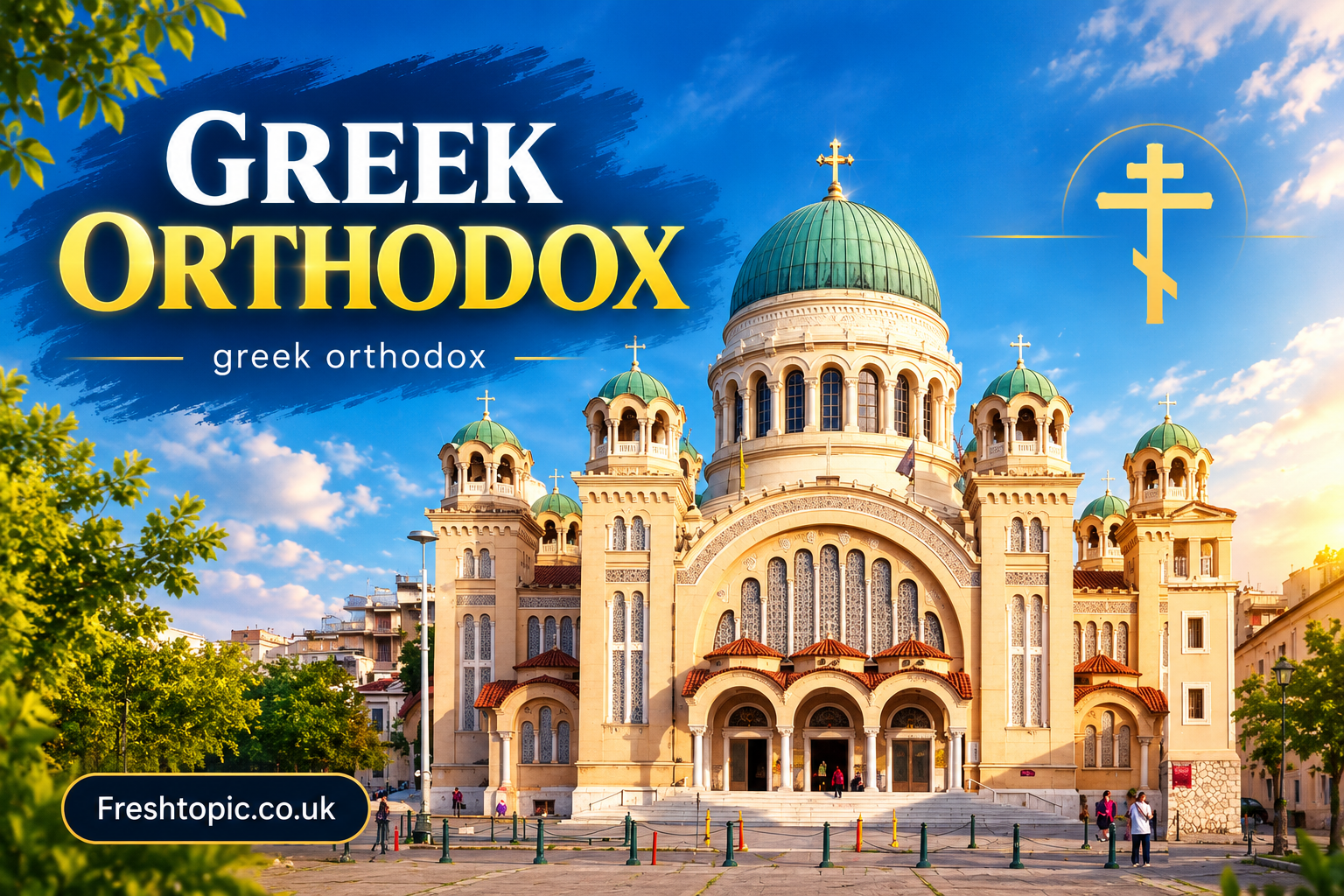
Ever heard someone mention the Greek Orthodox faith and wondered how it fits into the wider Christian world? You’re not alone. Many people confuse it with Catholicism, assume it’s only practiced in Greece, or have never encountered its rich symbolism and centuries-old rituals.
That confusion is understandable — the terminology can feel dense, and reliable, easy-to-digest explanations are surprisingly hard to find online.
Here’s the promise: by the end of this guide, you’ll clearly understand what the Greek Orthodox Church believes, what the Greek Orthodox cross symbolizes, and how Greek Orthodox Christmas traditions differ from what most Western audiences grew up with — all explained in plain language.
Greek Orthodoxy is a branch of Eastern Orthodox Christianity, one of the oldest continuous Christian traditions in the world. It traces its roots directly to the early Christian communities of the Byzantine Empire and remains one of the largest religious bodies globally, with an estimated 220 million Eastern Orthodox adherents worldwide, according to the Pew Research Center.
The Greek Orthodox Church: History and Core Beliefs
Origins and Historical Roots
The Greek Orthodox Church traces its lineage back to the Apostolic era, with strong historical ties to Constantinople (modern-day Istanbul), once the seat of the Byzantine Empire. The Great Schism of 1054 formally separated Eastern Orthodoxy from Roman Catholicism, largely over disputes about papal authority and theological interpretation.
Today, the Ecumenical Patriarchate of Constantinople is considered a spiritual leadership center for Greek Orthodox Christians, though each national Orthodox church (Greek, Russian, Serbian, and others) operates with a degree of independence. & more blogs digital .
Core Beliefs and Practices
Greek Orthodox Christianity centers on:
- The Holy Trinity — belief in one God expressed as Father, Son, and Holy Spirit
- Sacred Tradition — scripture interpreted alongside centuries of church teaching, not scripture alone
- The Divine Liturgy — the central worship service, rich with chant, incense, and ritual
- Icons — sacred images used as spiritual aids, not idols
- The Seven Sacraments — including Baptism, Chrismation, and the Eucharist
Unlike many Western denominations, Greek Orthodox worship leans heavily on mysticism, sensory experience, and unbroken tradition rather than modernized liturgy.
Interior of a Greek Orthodox church showing iconography and altar. “Greek Orthodox church interior with traditional icons”
The Greek Orthodox Cross: Symbolism and Meaning
The Greek Orthodox cross is one of the most recognizable symbols of the faith. While it shares similarities with other Christian crosses, it carries distinct visual and theological meaning.
The most iconic form is the Greek cross, featuring four arms of equal length, symbolizing balance, unity, and the four corners of the earth reached by the Christian gospel. Some variations include small serifs (crossbars) at the ends, while the Byzantine cross — often seen atop church domes — includes a small crescent at the base, historically interpreted as a symbol of Christ’s anchor of salvation, though it has also been linked to Byzantine imperial imagery.
How It Differs from Other Christian Crosses
| Cross Type | Arm Length | Common Association |
|---|---|---|
| Greek Orthodox Cross | Equal arms | Eastern Orthodox churches, Greece |
| Latin Cross | Longer vertical arm | Catholic and Protestant churches |
| Byzantine Cross | Equal arms + crescent base | Orthodox church domes |
| Celtic Cross | Equal arms + circle | Irish/Scottish Christian heritage |
Featured snippet-ready answer: The Greek Orthodox cross typically has four equal arms, unlike the Latin cross used in Western Christianity, which has a longer vertical beam.
Suggested image placement: Close-up of a Greek Orthodox cross on a church dome. “Greek Orthodox cross symbol on church dome”
Greek Orthodox vs. Catholic: Key Differences
| Category | Greek Orthodox | Catholic |
|---|---|---|
| Leadership | Ecumenical Patriarch (spiritual, not absolute authority) | Pope (supreme authority) |
| Language of Worship | Greek, local languages | Latin historically, now local languages |
| Clergy Marriage | Married priests permitted | Priests must remain celibate |
| Calendar | Often follows Julian calendar for feast days | Follows Gregorian calendar |
| View on Icons | Central to worship | Present but less liturgically central |
Pros of Greek Orthodox tradition: deep historical continuity, rich symbolic worship, strong community and family ties.
Cons some newcomers cite: services can be long, liturgical Greek/Church language may be unfamiliar, fewer English-language resources exist compared to Catholic or Protestant materials.
Greek Orthodox Christmas: Traditions and Dates
Greek Orthodox Christmas is one of the most searched aspects of this faith — largely because of date confusion.
Why the Date Sometimes Differs
Most Greek Orthodox communities, including the Church of Greece, celebrate Christmas on December 25, aligning with the Gregorian calendar. However, some Orthodox churches (like the Russian Orthodox Church) still follow the older Julian calendar, celebrating on January 7. This is a frequent point of confusion that even trips up long-time observers.
Christmas Eve and Day Customs
Common Greek Orthodox Christmas traditions include:
- A 40-day fasting period (Nativity Fast) leading up to Christmas, avoiding meat and dairy
- Christmas Eve carols (“Kalanda”) sung door-to-door by children
- Attending the Divine Liturgy on Christmas morning
- Christopsomo (“Christ’s Bread”) — a sweet, spiced bread baked for the occasion
- Family feasting after the fast ends, often featuring roasted pork or lamb
Table set with Christopsomo bread and traditional Greek Christmas dishes. “Greek’s Orthodox Christmas bread and holiday feast”
Why This Matters
Understanding Greek’s Orthodoxy isn’t just academic — it matters for interfaith understanding, travel etiquette, genealogy research, and respectful participation in weddings, funerals, or holiday gatherings within Greek’s Orthodox communities. Misunderstanding basic customs (like fasting periods or icon veneration) can unintentionally offend, while informed guests are often warmly welcomed.
Common Mistakes People Make About Greek Orthodoxy
- Assuming it’s identical to Catholicism — theology, leadership structure, and worship style differ meaningfully.
- Confusing all Orthodox Christmas dates — not every Orthodox church celebrates on January 7.
- Treating icons as decorative art — they hold devotional significance.
- Overlooking regional variation — Greek, Russian, and Serbian Orthodox practices, while related, aren’t interchangeable.
Expert Recommendations
If you’re exploring Greek’s Orthodoxy — whether for personal faith, heritage, or general curiosity — theologians and clergy commonly recommend:
- Attending a Divine Liturgy as an observer before forming conclusions from secondhand sources
- Reading primary Orthodox catechetical materials rather than relying solely on comparative religion summaries
- Speaking directly with a parish priest for questions about doctrine or family practices
- Respecting fasting periods and dress norms when visiting a Greek’s Orthodox church
Conclusion
Greek’s Orthodoxy carries centuries of history, distinctive symbolism, and traditions that remain vibrant today — from the meaning behind the Greek Orthodox cross to the customs shaping Greek Orthodox Christmas celebrations. Whether you’re researching heritage, preparing to attend a service, or simply curious, understanding these fundamentals helps you engage respectfully and knowledgeably.
FAQs
What is the difference between Greek Orthodox and Christian?
Greek’s Orthodox Christianity is a specific branch within the broader Christian faith, part of Eastern Orthodoxy, distinct from Catholic and Protestant branches.
Is Greek Orthodox the same as Catholic?
No. While both share early Christian roots, they split during the Great Schism of 1054 and differ in leadership structure, doctrine, and worship style.
What does the Greek Orthodox cross symbolize?
It typically symbolizes balance and the spread of the Christian gospel to all four corners of the earth, represented by its four equal arms.
When is Greek Orthodox Christmas?
Most Greek’s Orthodox Christians celebrate Christmas on December 25, though some Orthodox churches following the Julian calendar celebrate on January 7.
Do Greek Orthodox priests marry?
Yes, parish priests in the Greek’s Orthodox Church are generally permitted to marry before ordination, unlike Catholic priests.
In Short
- Greek Orthodoxy is a distinct, ancient branch of Christianity rooted in Byzantine tradition.
- The Greek Orthodox cross features four equal arms, differing from the Latin cross.
- Greek Orthodox Christmas is typically celebrated December 25, with some exceptions based on calendar traditions.
- Understanding these distinctions supports respectful, informed engagement with Greek Orthodox communities.