









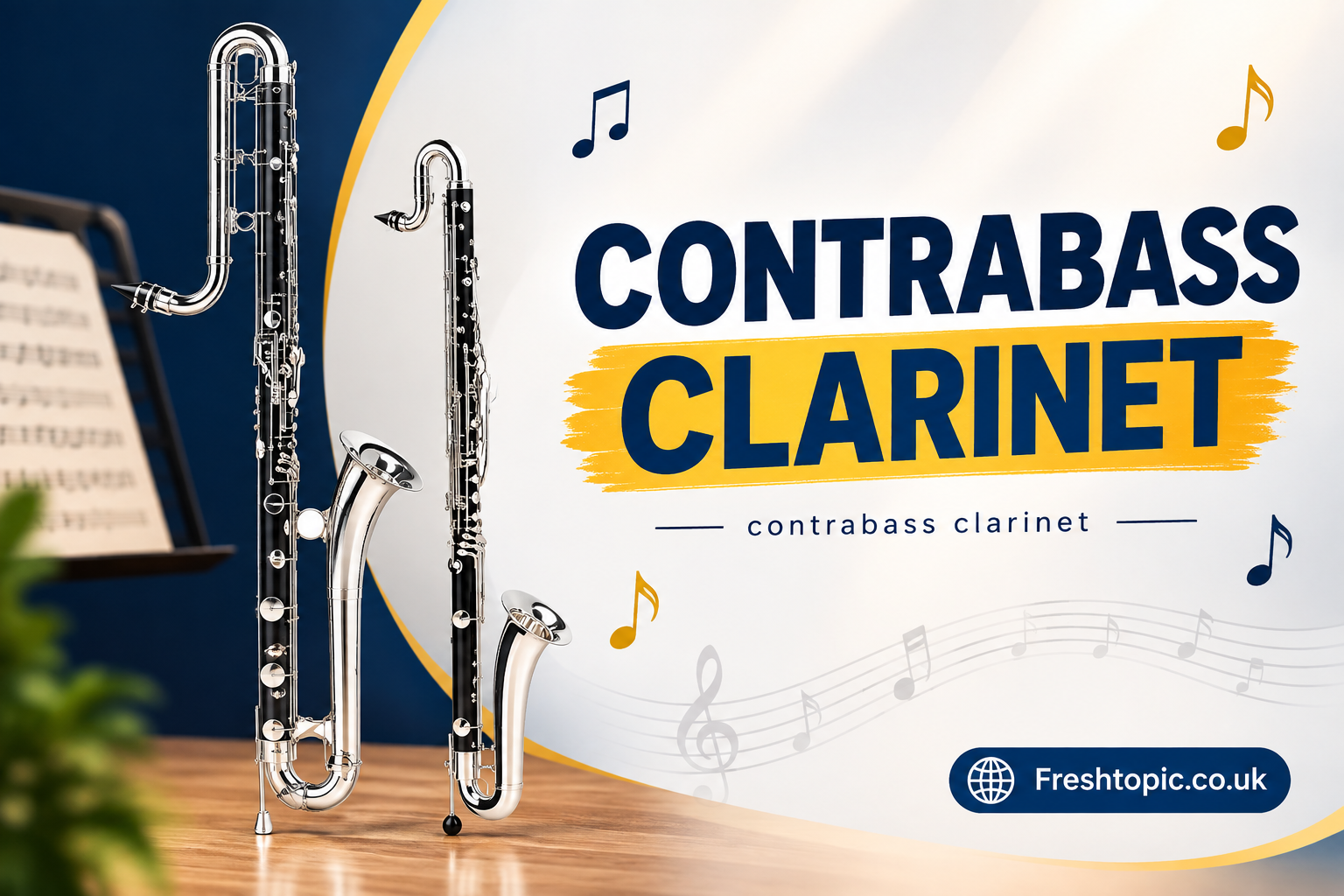

If you’ve ever stood in front of a marching band or wind ensemble and felt the floor rumble before you even heard the note, you’ve probably met a contrabass clarinet without knowing its name.
It’s the instrument band directors quietly hope someone will volunteer for, the one music stores rarely stock, and the one beginning players almost never see up close — because it’s expensive, rare, and genuinely intimidating to learn.
That scarcity creates a real problem: when a student or community musician finally gets access to one, there’s almost no beginner-friendly information available. Reed sizing is confusing. Fingering charts are scattered across forums and out-of-print PDFs. And buying one — new or used — can turn into a five-figure guessing game.
This guide fixes that. Below, you’ll get a full breakdown of what the contrabass clarinet actually is, how to choose reeds, where to find a reliable fingering chart, what to expect price-wise when buying one, and the mistakes most first-time players make.
What Is a Contrabass Clarinet?
The contrabass clarinet is the second-lowest member of the clarinet family (only the extremely rare octocontrabass goes lower). It’s a transposing instrument, almost always pitched in B♭, and it produces one of the deepest tones of any woodwind instrument played today.
Range and Transposition
The contrabass clarinet is notated in treble clef but sounds two octaves and a major second lower than written — meaning it sits two full octaves below the standard B♭ soprano clarinet and one octave below the bass clarinet. Depending on the model, the range extends down to written low E♭3, D3, or, on premium professional models, low C3, giving the instrument a sounding range as low as B♭0. & more blogs Neural .
Shape and Design (The “Paperclip” Legacy)
Many contrabass clarinets are built in the distinctive “paperclip” shape — the long metal tubing folded into a compact loop rather than left straight — a design popularized by Leblanc in the mid-20th century to make an otherwise unwieldy instrument more manageable to hold and transport. Modern professional models, particularly from Selmer Paris, instead use a taller, bass-clarinet-style body made from a combination of rosewood and metal.
A labeled diagram comparing the “paperclip” body style to the straight bass-clarinet-style body. Image alt text: “contrabass clarinet paperclip shape vs straight body design comparison”
Contrabass Clarinet Reeds
What Size Reed Does It Use?
This is one of the most searched — and most confusing — questions for new players. Dedicated contrabass clarinet reeds are uncommon, so most players use bass clarinet reeds, which are wider and longer than soprano clarinet reeds but still generally compatible with a contrabass mouthpiece’s facing.
Because reed availability is limited compared to soprano or even bass clarinet, many working contrabass players keep a larger-than-usual backup supply on hand, since local music stores rarely carry them in person.
Recommended Reed Strengths and Brands
- Strength range: Most players start around a 2.5–3 strength, adjusting based on mouthpiece facing and air support needs.
- Common brands: Bass clarinet reeds from established reed manufacturers are the standard substitute, since true contrabass-specific reeds are a niche product from specialty makers.
- Expert tip: Break in new reeds gradually over several short sessions — the sheer surface area of a contrabass reed makes it more prone to warping if it’s played hard right out of the box.
Contrabass Clarinet Fingering Chart
How Fingering Compares to Bass Clarinet
The good news for anyone coming from bass clarinet: contrabass clarinet fingering is nearly identical in the standard range. The Boehm system fingerings you already know transfer directly, which is why most contrabass players are recruited from the bass or soprano clarinet section rather than starting the instrument from scratch.
Where things get more complex is in the extended low register (models with a low C extension) and in the altissimo range, where quarter-tone and alternate fingerings become necessary for accurate intonation.
Where to Find a Reliable Chart
Because contrabass clarinet fingering varies slightly by manufacturer (Leblanc, Selmer, and Eppelsheim extended-range models each handle the lowest notes a little differently), general-purpose clarinet fingering charts often fall short. Specialty charts built specifically for extended-range contrabass models — covering the full written range from low C3 up through the altissimo register — are the most reliable resource for serious players.
Actionable recommendation: If you’re a student, ask your band director or a local university clarinet studio whether they have a manufacturer-specific chart before relying on a generic online diagram — the low-register keywork differs enough between brands to matter.
Contrabass Clarinet for Sale: What to Expect
New vs. Used Pricing
Buying a contrabass clarinet is nothing like buying a soprano clarinet. New professional models from Selmer Paris commonly retail well into the $25,000–$30,000 range, while used or vintage Leblanc “paperclip” models can be found through specialty woodwind dealers for roughly $10,000–$15,000, depending on condition, key extension, and finish.
Comparison Table: Buying Options
| Option | Typical Price Range | Best For |
|---|---|---|
| New professional (Selmer Paris) | $25,000–$30,000+ | Professionals, universities |
| Used Leblanc “paperclip” model | $10,000–$16,000 | Community bands, collectors |
| School/institutional rental | Rental fee, no purchase | Students, occasional players |
| Extended-range specialty builds (Eppelsheim) | Custom pricing, often $15,000+ | Advanced/professional players needing low C |
Expert tip: Because contrabass clarinets are a low-volume, specialty product, buying through an authorized dealer or a reputable used-woodwind specialist is strongly recommended over general marketplace listings — repair parts and mouthpieces are model-specific and hard to source blind.
Pros and Cons of Playing Contrabass Clarinet
| Pros | Cons |
|---|---|
| Unmatched low-end presence in an ensemble | High purchase and repair cost |
| Fingering transfers easily from bass clarinet | Limited reed and mouthpiece availability |
| Rare skill that makes you valuable to ensembles | Large size makes transport and storage difficult |
| Distinctive, powerful tone unlike any other woodwind | Fewer method books and instructional resources |
Why This Matters
Ensembles are chronically short on qualified low-clarinet players, and the contrabass clarinet in particular is one of the most under-documented instruments in modern band and orchestral literature. A student or community musician who understands reed sizing, fingering logic, and realistic buying expectations has a genuine advantage — both musically and in terms of ensemble opportunities — over players who go in unprepared and get discouraged by the instrument’s steep learning curve.
Understanding this instrument well also matters for band directors and purchasing decision-makers, who often have to justify a five-figure line item to a school board or ensemble budget committee with limited access to clear, trustworthy information.
Common Mistakes to Avoid
- Buying blind from a general marketplace listing. Contrabass clarinets need specialist inspection — pad condition, key extension authenticity, and bore integrity are easy to misjudge from photos alone.
- Assuming any bass clarinet reed will work perfectly. Reed compatibility depends heavily on the specific mouthpiece facing; test before committing to a box.
- Using a generic clarinet fingering chart for the extended low register. Manufacturer-specific low-note keywork differs enough to cause real confusion.
- Underestimating transport and storage needs. The instrument’s size and weight require a hard case and, often, a stand — factor this into your budget.
- Skipping a proper embouchure adjustment period. The air demands of a contrabass are significantly higher than soprano or even bass clarinet; rushing this leads to fatigue and poor tone.
Expert Recommendations
- For students: Start on bass clarinet if possible — the fingering overlap means you’ll transition to contrabass far faster than starting cold.
- For band directors: Budget for a rental or a well-vetted used instrument before committing to a new professional model; the used market has solid options from reputable dealers.
- For reed shopping: Buy bass clarinet reeds in bulk from a trusted brand and test strengths methodically rather than guessing based on your soprano or bass clarinet strength preference.
- For serious low-register players: Invest in a manufacturer-specific fingering chart rather than relying on general clarinet resources — it will save hours of frustration in the extended range.
Conclusion
The contrabass clarinet isn’t an instrument most musicians stumble into casually — it takes real air support, a specialist’s budget, and a willingness to hunt down manufacturer-specific resources that aren’t always easy to find. But for the right player or ensemble, it delivers a tone and low-end presence nothing else in the woodwind family can replicate.
If you’re weighing whether to take one on, start with the fundamentals covered here: understand your reed options, get a reliable fingering chart for your specific model, and go into any purchase with realistic pricing expectations.
Have you played contrabass clarinet, or are you considering picking one up for your ensemble? Share your experience in the comments — and if this guide helped clarify things, pass it along to a fellow low-reed player who’s still guessing.
FAQs
What reeds does a contrabass clarinet use?
Most players use bass clarinet reeds, since dedicated contrabass clarinet reeds are rare; strength typically starts around 2.5–3, adjusted for the specific mouthpiece.
How much does a contrabass clarinet cost?
New professional models typically range from $25,000 to $30,000+, while used vintage models can be found for roughly $10,000–$16,000 depending on condition and range.
Is contrabass clarinet fingering the same as bass clarinet?
Yes, in the standard range the Boehm-system fingerings are nearly identical; differences mainly appear in the extended low register and altissimo range, which vary by manufacturer.
What is the range of a contrabass clarinet?
Most models sound from roughly B♭0 up through E♭4, with the exact low end depending on whether the instrument has a low E♭, D, or C extension.
Why is the contrabass clarinet shaped like a paperclip?
The folded “paperclip” design, popularized by Leblanc, makes the instrument’s long tubing more compact and manageable to hold, rather than building it as one long straight tube.
Where can I buy a contrabass clarinet?
They’re typically sold through authorized dealers of major manufacturers like Selmer Paris and Leblanc, or through specialty used-woodwind retailers rather than general marketplaces.
Is the contrabass clarinet hard to play?
It requires more air support and embouchure endurance than soprano or bass clarinet, but the fingering system is familiar to any Boehm-system clarinetist, making the transition manageable with practice.
In Short
- The contrabass clarinet sounds roughly two octaves below the standard B♭ clarinet and one octave below bass clarinet.
- It commonly uses bass clarinet reeds rather than a dedicated reed size, typically in the 2.5–3 strength range.
- Fingering is nearly identical to bass clarinet in the standard range, with manufacturer-specific differences in the extended low register.
- New professional models run $25,000–$30,000+, while used models can be found for roughly $10,000–$16,000.
- Buying from a specialist dealer is strongly recommended over general marketplace listings.