









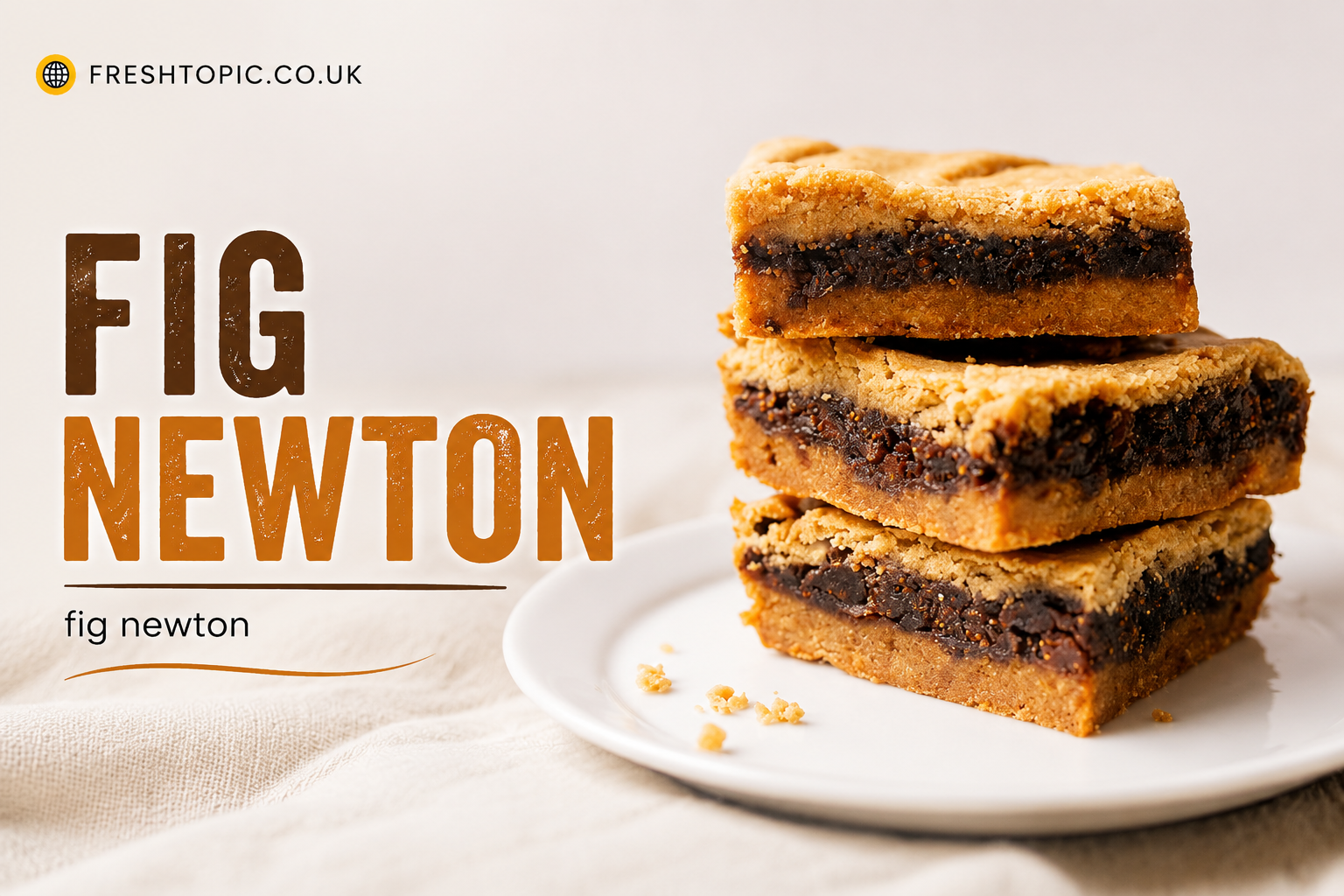
You grab a package of Fig Newton bars off the pantry shelf, and a familiar question pops into your head: are these actually a healthy snack, or just a cookie wearing a fruit-flavored disguise?
It’s a fair question. Fig Newtons have spent over a century straddling the line between “cookie” and “health food” — marketed for decades as a wholesome, fruit-filled alternative to candy, while still living in the cookie aisle next to Oreos. If you’re trying to track calories, manage sugar intake, or just satisfy a craving without guilt, that ambiguity matters.
Here’s what this guide clears up: exactly what’s in a Fig Newton nutrition label, how many Fig Newton calories you’re really eating per serving, how the bars compare to other snack cookies, and — if you’d rather skip the preservatives — a simple Fig Newton recipe you can make at home tonight.
By the end, you’ll know precisely where Fig Newtons fit into your diet, and whether the “healthier cookie” reputation actually holds up.
What Is a Fig Newton Bar, Exactly?
A Fig Newton is a soft, cake-like cookie wrapped around a fig jam filling — technically a “fig roll,” a category of fruit-filled cookie that predates the American brand by decades. Nabisco (now owned by Mondelez International) has manufactured them since the 1890s, and they remain one of the best-known fig newton bars in American grocery stores.
A Quick History: From “Newton” to “Fig Newton”
The cookie’s origin story is more interesting than most snack foods get. In 1891, Philadelphia baker Charles Roser sold his fig-paste-filled pastry recipe to the Kennedy Biscuit Company near Boston. A machine invented by James Henry Mitchell allowed the simultaneous extrusion of fig jam and cookie dough into a long, continuous roll, and production began at the F. A. Kennedy Steam Bakery in 1891. The plant manager, James Hazen, named the cookie “Newton” after the nearby Boston suburb of Newton, Massachusetts — following the bakery’s habit of naming products after local towns. & more blogs digital .
When Kennedy Biscuit merged into what eventually became Nabisco, the cookies were trademarked as “Fig Newtons”. Interestingly, since 2012, “Fig” has been dropped from the official product name — it’s now marketed simply as “Newtons,” in part because the brand had expanded into strawberry, raspberry, and blueberry flavors, and in part due to a perceived old-fashioned association with figs. Most consumers, though, still call the original variety “Fig Newtons,” which is why that’s the name this guide uses.
Vintage Fig Newtons advertisement or package — Alt text: “History of Fig Newton bars since 1891”]
Fig Newton Nutrition Facts (Official Label Data)
Fig Newton Calories by Serving Size
Calorie counts for Fig Newton bars vary depending on which product line you buy — the classic soft-baked version, the 100% whole grain version, or individual snack packs. Here’s what’s currently on the label:
| Product | Serving Size | Calories |
|---|---|---|
| Newtons Fig, 100% Whole Grain | 2 cookies | 100 |
| Newtons Fig, Soft & Chewy (original) | 3 pieces | 150 |
| Newtons Fig snack pack (2 oz) | 1 pack (2 cookies) | 200 |
A standard serving of Fig Newtons (2 whole grain cookies) contains 100 calories, with the original soft & chewy version running closer to 150 calories per 3-cookie serving.
Full Nutrition Breakdown
Here’s the complete nutrition panel for the 100% whole grain variety (2-cookie serving), which is the most common reference point used today:
| Nutrient | Amount | % Daily Value |
|---|---|---|
| Calories | 100 | — |
| Total Fat | 1.5g | 2% |
| Saturated Fat | 0g | 0% |
| Sodium | 95mg | 4% |
| Total Carbohydrate | 22g | 8% |
| Dietary Fiber | 2g | 7% |
| Total Sugars | 12g | — |
| Added Sugars | 9g | 18% |
| Protein | 1g | — |
For comparison, the original Soft & Chewy formula (3-cookie serving) comes in at 150 calories, 3g fat, 140mg sodium, 31g carbs, 3g fiber, and 17g total sugars (12g added).
Ingredients List Explained
The current whole grain Fig Newtons ingredient list reads: whole grain wheat flour, figs, sugar, corn syrup, invert sugar, soybean and/or canola oil, soluble corn fiber, palm oil, oat fiber, salt, resistant corn maltodextrin, baking soda, calcium lactate, malic acid, soy lecithin, sodium benzoate (a preservative), natural and artificial flavor, and sulfur dioxide (used to preserve the figs).
A few things worth knowing:
- No high-fructose corn syrup — Nabisco has phased this out of the current formula.
- Multiple sweeteners are still used (sugar, corn syrup, invert sugar), which is how a “fruit cookie” ends up with 9–12g of added sugar per serving.
- Whole grain wheat flour is now the first ingredient in the whole grain variety, meaning it technically contains more whole grain than white flour by weight.
- Contains wheat and soy — not suitable for gluten-free or soy-allergic diets.
Close-up of Fig Newton nutrition label — “Fig Newton nutrition facts label showing calories and sugar content”]
Are Fig Newton Healthy? How They Compare to Other Cookies
This is the question most people are really asking. The honest answer: Fig Newtons are a moderately better choice than a lot of packaged cookies, but they’re still a cookie — not a health food.
On the plus side, they contain real fruit (fig paste), some dietary fiber, no high-fructose corn syrup, and relatively low fat compared to cream-filled or chocolate cookies. On the downside, they’re still high in added sugar relative to their size, made primarily from refined and enriched flour blends, and contain preservatives and multiple processed sweeteners.
Fig Newtons vs. Oreos vs. Graham Crackers
| Snack | Calories (per ~30g serving) | Total Fat | Added Sugar | Fiber |
|---|---|---|---|---|
| Fig Newtons (whole grain) | 100 | 1.5g | 9g | 2g |
| Oreo cookies (3) | ~160 | 7g | 14g | <1g |
| Graham crackers (2 sheets) | ~130 | 3g | 8g | 1g |
Compared to Oreos, Fig Newtons have less fat and fewer calories per serving, but a similar amount of added sugar relative to serving size — making them a modest improvement, not a low-sugar snack.
Homemade Fig Newton Recipe
If you’d rather control the sugar, skip the preservatives, and use real ingredients you recognize, homemade Fig Newtons come together in under an hour of active time (plus chilling).
Ingredients You’ll Need
For the fig filling:
- 1½ cups dried figs, stems removed
- ¾ cup water or orange juice
- 2 tablespoons honey or sugar
- 1 teaspoon lemon juice
For the cookie dough:
- 2¼ cups all-purpose flour (or half whole wheat)
- ½ teaspoon baking soda
- ¼ teaspoon salt
- ½ cup unsalted butter, softened
- ½ cup brown sugar
- 1 egg
- 1 teaspoon vanilla extract
- 2 tablespoons milk
Step-by-Step Instructions
- Make the filling. Simmer the dried figs, water (or orange juice), and honey in a small saucepan for 10–12 minutes until softened. Stir in lemon juice, then blend or process until you get a thick, jam-like paste. Let it cool completely.
- Make the dough. Cream the butter and brown sugar until fluffy. Beat in the egg, vanilla, and milk. Gradually mix in the flour, baking soda, and salt until a soft dough forms.
- Chill the dough. Wrap and refrigerate for at least 30 minutes — this makes rolling much easier.
- Roll and fill. On a floured surface, roll the dough into a rectangle about ¼-inch thick. Spread a thin line of fig filling down the center third of the dough.
- Fold and seal. Fold the two long edges of the dough over the filling, pinching the seam closed, to form a long log.
- Slice and bake. Cut the log into 2-inch bars, place seam-side down on a parchment-lined baking sheet, and bake at 350°F (175°C) for 15–18 minutes, until lightly golden.
- Cool completely before storing in an airtight container for up to a week.
Expert tip: Swap the dried figs for a mix of dried figs and dates if you want a slightly sweeter, softer filling without adding extra sugar.
Homemade fig newton bars cooling on a wire rack — “Homemade fig newton bars recipe with fig filling”]
“More homemade fruit bar recipes”
Why This Matters
Snack food nutrition labels are often designed to look better than they are — small serving sizes, “made with real fruit” claims, and whole-grain marketing can make a product seem healthier than the sugar content actually supports. Fig Newtons are a textbook example of this tension: they’ve marketed themselves as a wholesome snack since the 1890s, and while the current formula has improved (no high-fructose corn syrup, added whole grains), the added sugar content is still substantial for the serving size.
Understanding the real numbers matters for:
- Parents packing lunchboxes who want an accurate picture of sugar intake
- People managing blood sugar or weight who need real serving-size math, not marketing copy
- Home bakers who want a lower-sugar, preservative-free alternative
- Anyone curious about food history and how a 130-year-old product has changed (or hasn’t) to meet modern nutrition standards
Pros and Cons of Fig Newtons
Pros
- ✅ Contains real fig fruit and some dietary fiber
- ✅ Lower in fat than most cream-filled or chocolate cookies
- ✅ No high-fructose corn syrup in the current formula
- ✅ Widely available, shelf-stable, and portion-controlled in snack packs
Cons
- ❌ Still relatively high in added sugar per serving (9–15g depending on size)
- ❌ Made with refined/enriched flour blends alongside whole grain flour
- ❌ Contains preservatives (sodium benzoate) and multiple processed sweeteners
- ❌ Not suitable for gluten-free or soy-free diets
Mistakes to Avoid When Eating or Baking Fig Newtons
- Assuming “fruit cookie” means low sugar. A 2-cookie serving still has 9–12g of added sugar — comparable to a small dessert.
- Ignoring serving size differences between product lines. The whole grain version, original version, and snack packs all have different calorie counts per serving — check the specific package you’re buying.
- Overfilling homemade bars with fig paste. Too much wet filling makes the dough tear and leak during baking; a thin, even line works best.
- Skipping the chill step in homemade dough. Unchilled dough is sticky and hard to roll evenly, leading to uneven baking.
- Storing homemade bars uncovered. Without preservatives, homemade Fig Newtons dry out fast — always store in an airtight container.
Expert Recommendations
- Watching added sugar? Choose the whole grain 2-cookie serving (100 calories, 9g added sugar) over the original 3-cookie serving (150 calories, 12g added sugar) — it’s the lower-sugar option per package.
- Baking at home? Use a mix of dried figs and a small amount of citrus juice to naturally deepen sweetness without piling on refined sugar.
- Meal-prepping snacks? Pre-portion homemade or store-bought Fig Newtons into single servings — the biggest overconsumption risk with any packaged cookie is eating straight from the box.
- Have a gluten or soy allergy? Skip Fig Newtons entirely (they contain both wheat and soy) and look for dedicated allergen-free fig bar brands instead.
Conclusion
So, are Fig Newton bars a smart snack or just a well-marketed cookie? The honest answer sits in the middle: they’re a reasonable, portion-controlled treat with real fruit and less fat than most cookies — but the Fig Newton calories and added sugar numbers mean they’re still a dessert, not a diet food. Whether you stick with the store-bought version or try the homemade recipe above, knowing the actual Fig Newton nutrition numbers puts you in control of how they fit into y
FAQs
How many calories are in a Fig Newton?
A 2-cookie serving of whole grain Fig Newtons contains 100 calories. The original Soft & Chewy variety runs about 150 calories per 3-cookie serving, and individual 2 oz snack packs contain around 200 calories.
Are Fig Newtons healthy?
Fig Newtons are a moderate choice compared to many packaged cookies — lower in fat, made with real fig fruit, and free of high-fructose corn syrup — but they still contain 9–15g of added sugar per serving, so they’re best treated as a treat rather than a health food.
What are Fig Newtons made of?
Current Fig Newtons are made from whole grain wheat flour, figs, sugar, corn syrup, invert sugar, vegetable oils (soybean, canola, and palm), oat and corn fiber, salt, and preservatives including sodium benzoate.
Why are they called Fig Newtons if they don’t have “Fig” in the name anymore?
Fig Newtons were renamed simply “Newtons” in 2012 to reflect the expanded lineup of fruit flavors beyond fig, though most people still use “Fig Newton” to refer to the original fig variety.
Can you make Fig Newtons without refined sugar?
Yes — a homemade fig filling made from simmered dried figs, honey, and lemon juice can replace refined sugar in the filling, though the cookie dough itself typically still needs some sugar for texture and browning.
Are Fig Newtons vegan?
Store-bought Fig Newtons are not strictly vegan, as they may contain shared-equipment dairy traces and some formulations include non-vegan preservatives; always check the current package. Homemade versions can easily be made vegan by substituting plant-based butter and a flax egg.
How long do homemade Fig Newtons last?
Homemade Fig Newtons typically stay fresh for about 5–7 days in an airtight container at room temperature, or up to 2 weeks refrigerated, since they lack the preservatives found in store-bought versions.
In Short
- A standard 2-cookie serving of whole grain Fig Newton bars contains 100 calories, 9g added sugar, and 2g fiber.
- Fig Newton nutrition varies by product line — original, whole grain, and snack packs all carry different per-serving calorie counts.
- Fig Newtons are a modest step up from many packaged cookies (lower fat, real fruit, no high-fructose corn syrup) but still carry meaningful added sugar.
- A homemade Fig Newton recipe using dried figs, honey, and simple cookie dough lets you control sugar and skip preservatives entirely.
- The cookie dates back to 1891 and was named after Newton, Massachusetts — not physicist Isaac Newton, despite the popular myth.