









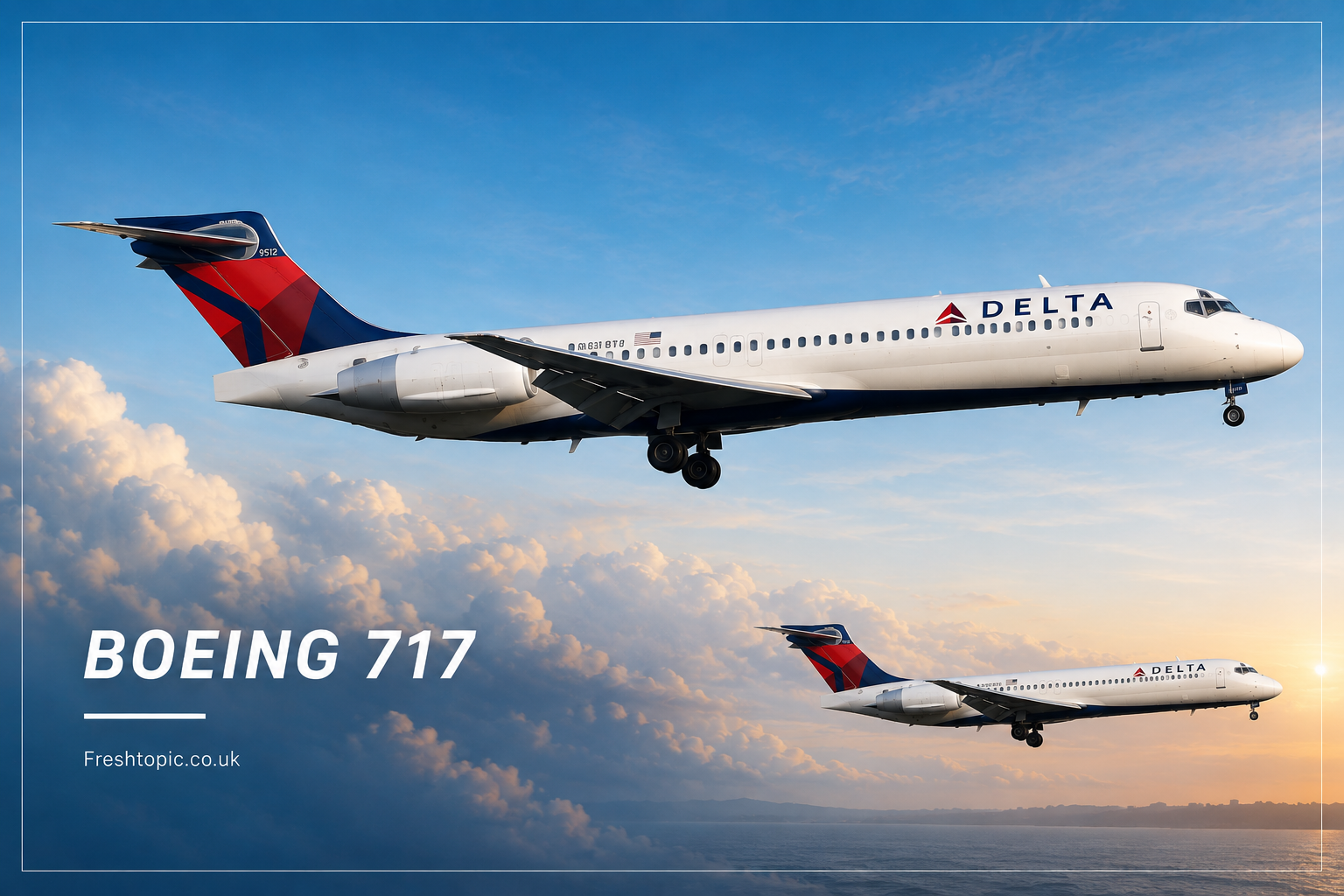
You’ve just been assigned a seat on a “Boeing 717” for your next flight, and now you’re doing exactly what most travelers do — Googling it. Is it a full-size jet or a puddle-jumper? Is it safe? And where should you actually sit to avoid a bad three-hour flight?
The Boeing 717 is a twin-engine, single-aisle regional jet built for short-haul routes, seating around 110–128 passengers depending on the airline’s configuration. It’s the smallest jet in Boeing’s post-merger commercial lineup, and today it flies almost exclusively for Delta Air Lines and Hawaiian Airlines in the U.S.
This guide covers everything worth knowing before you board one: its real safety record, Delta’s exact seat map, and how it stacks up against other regional aircraft.
From MD-95 to Boeing 717: A Brief History
The Boeing 717 didn’t start life as a Boeing product. It began as the McDonnell Douglas MD-95, itself a descendant of the DC-9 — one of the most successful airliner families ever built. When Boeing acquired McDonnell Douglas in 1997, the MD-95 was already close to launch, and Boeing rebranded it as the 717-200 rather than scrapping it outright.
The jet entered service in 1999, but it launched into a crowded market already dominated by the Boeing 737 family and Airbus A320. Only 155 aircraft were ever delivered before production ended in May 2006, making it something of a commercial footnote — even as it quietly built one of the best safety records in commercial aviation. & more blogs to see Neural .
Key Specifications
- Cruise speed: 504 mph (811 km/h)
- Range: approximately 1,510 miles (2,430 km)
- Engines: 2 turbofans, fuselage-mounted at the rear (Rolls-Royce BR715)
- Length: 124 ft (37.8 m)
- Wingspan: 93 ft 4 in (28.45 m)
- Typical seating: five-abreast (2-3 layout), 110–128 seats depending on airline configuration
Has a Boeing 717 Ever Crashed?
No — as of the most recent data available, the Boeing 717 has never been involved in a fatal accident or a hull-loss event. This makes it one of the very few commercial jet types with a completely clean fatality record across its entire operational history.
The 717’s Actual Safety Record
As of March 2025, the Boeing 717 had been involved in six total aviation accidents and incidents — with zero hull losses and zero fatalities. The incidents on record include relatively minor events: an on-ground collision while taxiing, an emergency landing where the nose landing gear failed to extend, and one attempted hijacking. None resulted in the loss of an aircraft or a passenger life.
That track record has made the 717 a quiet favorite among aviation safety analysts, who regularly cite it alongside a small handful of aircraft types with zero hull-loss history.
The 2024 Wing Crack Airworthiness Directive
In October 2024, the FAA issued an airworthiness directive after inspectors discovered multiple cracks in the wings of some 717s, including one crack approximately 7 inches long that was deemed not capable of sustaining a limit-load event. This led to mandated inspections and repairs across the fleet — a normal part of maintaining an aging aircraft type, and one that did not result in any accidents. It’s worth knowing about if you’re researching the aircraft’s current condition, since fleet age is a legitimate factor as the 717 approaches the end of its service life with major U.S. carriers.
Boeing 717-200 Delta Seat Map
Delta is the largest operator of the Boeing 717-200, running a consistent three-class configuration across its fleet: 110 total seats, split between Delta First, Delta Comfort+, and Delta Main Cabin.
Delta First
- Rows: 1–3
- Layout: 2-2 (seats A, B | C, D)
- Seat pitch: 37 inches
- Seat width: 19.6 inches
- Total seats: 12
Delta First on the 717 uses classic recliner-style seats built by Zodiac Aerospace (model 6810), with power outlets at every seat.
Delta Comfort+
- Located behind First Class, typically rows 10–14 (varies slightly by exact fleet configuration)
- Layout: 2-3
- Seat pitch: 33–34 inches
- Total seats: roughly 15–25 depending on source and configuration
Delta Main Cabin
- Remaining rows, filling out the aircraft to 110 total seats
- Layout: 2-3 (only one middle seat per row, seat D — the port side never has a middle seat)
- Seat pitch: 31 inches
Best and Worst Seats to Pick
Because the 717’s engines are mounted at the rear of the fuselage rather than under the wings, the front two-thirds of the cabin is noticeably quieter — a meaningful comfort factor on longer regional routes.
Seats to look for:
- 3A or 3D — often cited as top First Class picks, away from the forward lavatory queue
- 12A or 12E — solid Comfort+ options with the quieter forward cabin
- 21A or 21E — good Main Cabin choices further from the rear engine noise
- 20B — a rare true solo seat on some configurations, with no seatmate due to an adjacent exit door
Seats to avoid:
- The last two rows, which sit closest to the engines and are noticeably louder
- Seats near the single forward lavatory, which can see a recurring line during the flight
- Note that WiFi reliability has historically been inconsistent across the 717 fleet, so don’t count on connectivity for a longer flight
Boeing 717 vs. Other Regional Jets: Comparison Table
| Boeing 717-200 | Embraer E175 | CRJ-900 | Airbus A220-100 | |
|---|---|---|---|---|
| Typical seats | 110–128 | ~76 | ~76–90 | ~100–135 |
| Seating layout | 2-3 (5-abreast) | 2-2 (4-abreast) | 2-2 (4-abreast) | 2-3 (5-abreast) |
| Engine placement | Rear-mounted | Wing-mounted | Rear-mounted | Wing-mounted |
| Range | ~1,510 miles | ~2,000 miles | ~1,500 miles | ~3,400 miles |
| Cabin width feel | Wider, mainline-style | Narrower, regional-jet feel | Narrower, regional-jet feel | Wider, mainline-style |
| In production today | No (ended 2006) | Yes | No (ended 2020) | Yes |
| U.S. operators | Delta, Hawaiian | Multiple regional carriers | Multiple regional carriers | Delta, JetBlue, Air Canada |
Pros of the 717: wider mainline-style cabin than most true regional jets, quiet front cabin, strong safety record, generous overhead bin space. Cons: aging fleet with limited remaining service life, inconsistent WiFi, loud rear rows, and no ongoing production or parts pipeline.
Why This Matters
Understanding what aircraft you’re flying on isn’t just aviation trivia — it directly affects your comfort, your seat choice, and, for some travelers, peace of mind about safety. The Boeing 717’s rare combination of a clean safety record and a comfortable, wider-than-typical regional cabin explains why frequent flyers often specifically look for it when booking short domestic routes, rather than treating it as just another interchangeable regional jet.
Expert Recommendations
- Nervous flyers: The 717’s safety record — zero hull losses, zero fatalities — is genuinely one of the strongest in commercial aviation and worth knowing if flight anxiety is a factor.
- Seat selectors: Choose forward-cabin seats (rows 1–14 depending on class) for a quieter ride; avoid the last two rows near the engines.
- Business travelers: Don’t count on WiFi working reliably — download entertainment or work offline before boarding.
- Frequent Delta flyers: Check your specific aircraft’s seat map before booking, since Comfort+ row ranges can vary slightly by individual aircraft configuration.
Common Mistakes to Avoid
- Assuming the Boeing 717 is a small “puddle-jumper” — its five-abreast layout and mainline-style cabin feel is wider than true regional jets like the CRJ or E175.
- Booking a rear-row seat expecting a quiet flight — the last two rows sit closest to the rear-mounted engines.
- Relying on in-flight WiFi for anything time-sensitive, given historically inconsistent connectivity across the fleet.
- Confusing the 717’s safety record with other aircraft types — its zero-fatality history is specific to this aircraft, not Boeing’s broader lineup.
Conclusion
The Boeing 717 is a rare thing in aviation: a commercial “failure” by sales numbers that turned into one of the safest aircraft types ever built, with zero fatalities and zero hull losses across its entire service history. For travelers, that track record — paired with a wider, quieter-than-expected cabin — is exactly why the 717 has quietly earned a loyal following among Delta and Hawaiian Airlines flyers.
Next time you’re booked on a 717, use the seat map above to grab a quieter forward-cabin seat, and fly knowing you’re on one of the most reliably safe aircraft in the sky.
FAQs
Has a Boeing 717 ever crashed?
No — the Boeing 717 has never been involved in a fatal crash or hull-loss accident throughout its operational history, based on the most recent available data.
Is the Boeing 717 a safe plane to fly on?
Yes. It has one of the cleanest safety records of any commercial jet type, with no fatalities and no hull losses recorded as of the latest data.
How many seats does Delta’s Boeing 717-200 have?
Delta’s Boeing 717-200 typically seats 110 passengers across three cabins: Delta First, Delta Comfort+, and Delta Main Cabin.
What is the best seat on a Delta Boeing 717?
Seats in the forward half of the cabin — such as 3A/3D in First Class or 12A/12E in Comfort+ — tend to be quieter, since the 717’s engines are rear-mounted.
Why did Boeing stop making the 717?
Boeing ended 717 production in 2006 after only 155 deliveries, as the aircraft struggled to compete against the more established Boeing 737 and Airbus A320 families in a crowded market.
Does the Boeing 717 have WiFi?
Some Boeing 717s have WiFi, but connectivity has historically been inconsistent across the fleet, so travelers shouldn’t count on it for time-sensitive tasks.
In Short
- The Boeing 717 began as the McDonnell Douglas MD-95 before Boeing rebranded it following their 1997 merger.
- It has a clean safety record: no fatal accidents and no hull losses throughout its operational history.
- Delta’s Boeing 717-200 seats 110 passengers in a three-class configuration (First, Comfort+, Main Cabin).
- The aircraft’s rear-mounted engines make the front two-thirds of the cabin noticeably quieter than the back.
- Compared to true regional jets like the CRJ-900 or E175, the 717 offers a wider, more mainline-style cabin experience.